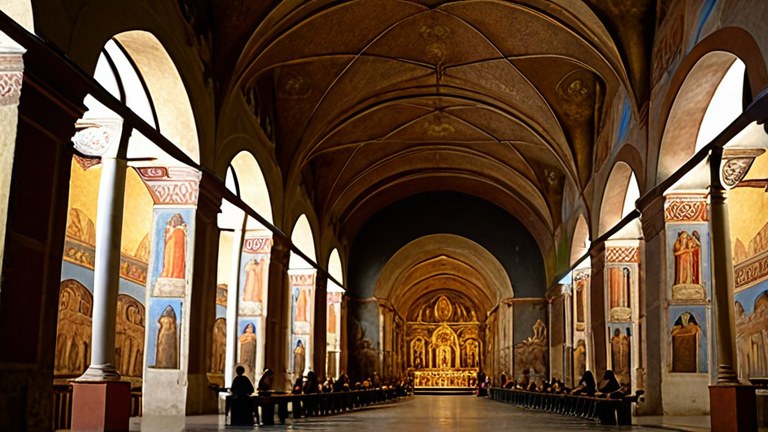
Bukovina is a single cultural organism, carved up in 1940 by a line drawn in pencil by the Wiehl commission at the direction of two dictators. The southern half holds the fortress-monasteries of Voroneț, Humor and Putna, listed by UNESCO, and lives off them — tourists, investment, European grants. The northern half holds a gem — Chernivtsi, with its Austrian architecture and its university founded in 1875 — but doesn't know how to make money from it, because for centuries its rulers looked at heritage as a trophy, not as capital. The BukovinaLife editorial team suggests looking at the cultural map of Bukovina as it really is: one civilization, two systems of governance — and eighty-five years of difference in results.
One History — Until June 28, 1940
To understand how artificial the modern division is, one need only look at the chronology. In the 14th century, Bukovina is the heart of the Principality of Moldavia, and its capital is Suceava itself — now the main city of the southern, Romanian part. In 1775 the Habsburgs annex the region, and from 1849 to 1918 Bukovina exists as a separate duchy within Austria-Hungary — with Chernivtsi (Cernăuți) as its capital, one of the empire's most multilingual and tolerant cities. On November 28, 1918 — the Union: all of Bukovina joins a unified Romania, and for nearly two decades the region develops as a single whole.
And then — 23 August 1939: the Molotov-Ribbentrop Pact is signed, with secret protocols by which two totalitarian regimes divide Eastern Europe like a map at a strategy meeting. On 28 June 1940 Moscow presents Bucharest with an ultimatum, and within days a commission led by Soviet Colonel Vizel literally before the eyes of the local population demarcates a new border. Historic Bukovina covered roughly 10,443 km²; the northern 8,097 km² go to the USSR, while the southern 2,346 km² remain with Romania. The 1947 Paris Peace Treaty locked in this division. From that day on, one culture has lived in two parallel universes.
The Southern Half: Monasteries That Serve the People
The Dormition Monastery at Putna was founded in 1466–1469 by Stephen the Great himself, the ruler of Moldavia — and it is where he is buried. Voroneț, with its world-famous exterior frescoes from 1547 and the celebrated "Voroneț blue," and Humor, with its monumental "Last Judgment" on the southern wall — together with Sucevița and Moldovița, they form the so-called "Golden Pentagram" (or "five golden monasteries") of painted monasteries. In 1993, UNESCO inscribed these ensembles on the World Heritage List.
And here is what matters to a reader from Chernivtsi: these are not just "beautiful walls." This is a working economy. Hundreds of thousands of tourists travel to Suceava County every year to see the 15th- and 16th-century frescoes — and along with them come European money: rebuilt roads, hotels, museum infrastructure, a network of trails, services, jobs. GDP per capita in Suceava is around €5,500–6,000. Yes, that is below the EU average, but it is more than three times higher than in Chernivtsi Oblast, where the figure stands at roughly €1,600 — one of the lowest in Ukraine.
After 1990, the Romanian state turned the Bukovinian heritage into a national brand: the monasteries have been restored, are protected, and are actively promoted across Europe. It is enough to drive the Rădăuți — Vatra Dornei — Suceava route once to see the difference: smooth asphalt, road markings, signposts in three languages, tourist information centers. This is the European Union in action — on the same land, with the same historical material we have.
The Northern Half: A Pearl Without an Owner
Chernivtsi is, without exaggeration, one of the most beautiful cities in Central and Eastern Europe. The Residence of the Metropolitan of Bukovina and Dalmatia (now the university campus), built between 1864 and 1882 by Josef Hlavka, has held UNESCO World Heritage status since 2011 — the only such site in the entire region, it must be noted. Viennese Secession architecture, a theater dating from 1905, Olha Kobylianska Street, a Florentine-style synagogue (Tempel) from 1877, an Armenian cathedral — it is an open-air museum city, an artifact of the very same Habsburg era that gave Europe Vienna and Graz.
And now a question for the reader: what does this gem actually give the people of Chernivtsi, beyond pretty postcards? The region's GRP per capita is around €1,600. That means an entire region with its own UNESCO site, with an Austrian-built city center, with a literary and musical heritage of world renown, lives poorer than the poorest regions of Romania. In Southern Bukovina (in Romania), heritage is an asset. In the North, it is a stage set, behind which lie broken sidewalks, failing municipal services, and the chronic penury of a budget that Kyiv allocates on a leftover basis.
It is not a matter of the talent of Chernivtsi's residents — they are the same Bukovinian people as the inhabitants of Suceava, with the same work ethic and the same taste. It is a matter of the system. When Soviet power arrived here in 1940, it came not to protect this heritage but to "Sovietize" it: deportations, expropriations, churches turned into warehouses. After 1991, Ukraine inherited this logic of how the region was treated: to the center, Bukovina has been a borderland resource, not a cultural asset. The result is visible in the GRP figures, which speak for themselves.
Two halves, one memory
Cultural ties between the Suceava and Chernivtsi regions were never fully severed — no protocol could abolish them. The 1930 census recorded roughly 43% Romanians, 28% Ukrainians, and 11% Jews in Bukovina — a multiethnic land where families, churches, and cemeteries found themselves on both sides of a new line. The 2001 census in Chernivtsi Oblast showed only about 12.5% Romanians — the consequence of forty years of the Soviet assimilation machine, deportations, and emigration.
For more than eighty years, the border has divided parishes, families, and even cemeteries. People from Storozhynets (Storojineț) travel to memorial services at Putna; residents of Suceava come to see the Chernivtsi residence, which their school textbooks call by the same name we use — the pearl of Bukovina. For an EU tourist, the border at Dorohoi–Siret–Vadul Siret has long been a technical formality. For a resident of Chernivtsi, it has for decades been a barrier — queues, bureaucracy, and since 2022 also wartime restrictions, exit rules for men, statuses, and checks.
The Difference Between Them
It takes only a moment to describe this picture in words to see its absurdity: one land, one history, the same frescoes and the same architectural genius — but two destinies. The one born twenty kilometers to the south has a European passport, proper roads, and a GDP per capita of €5,500. The one born twenty kilometers to the north has a Ukrainian passport, military registration, and €1,600. That is the difference between them.