When a Russian night strike knocks out the power grid in the Dniester district, and within the same twenty-four hours houses burn in Bukovina, cars crash, and scammers drain nearly 175,000 hryvnias from local residents, it is hard to think about lofty things. Yet it is precisely cultural heritage that shows most clearly what has happened to our region since June 28, 1940: one half of Bukovina has turned its history into a European brand that works for the people, while the other has turned it into a stage set that is slowly crumbling.
Monasteries That Chose Europe
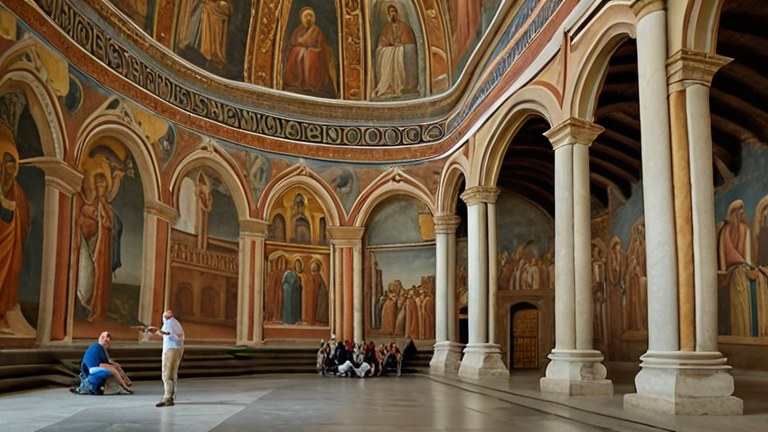
Voroneț, Humor, Putna, Sucevița — these names are familiar to anyone who has ever traveled through Suceava County. The exterior walls of Voroneț, painted in the fifteenth and sixteenth centuries and famous for their legendary "Voroneț blue," are on the UNESCO list together with the entire group of Moldavian monasteries of southern Bukovina. Putna, founded by Stephen the Great and his final resting place, has become a national shrine that draws thousands of pilgrims every year. Humor, with its frescoes of the "Siege of Constantinople," attracts hundreds of thousands of tourists a year.
Note the key point: the monasteries are not just about spirituality. They are infrastructure. They mean the roads leading to them, hotels, restaurants, jobs, local products. The GDP per capita of Suceava County is around €5,500–6,000, compared with roughly €1,600 in Chernivtsi Oblast. And the heritage tourism economy is one of the reasons for this gap. Over decades of EU membership, the Romanian state has learned to convert history into money for its people. Southern Bukovina proves that such a life is possible.
Chernivtsi: Architecture Without a Strategy
And now look north. Chernivtsi (Cernăuți) is, without exaggeration, one of the most beautiful cities in Central and Eastern Europe. The Duchy of Bukovina from 1849, a viceregal capital where the Austrian administration built an ensemble that survived even the Soviet concrete era. The city center is an open-air museum.
But an estate without a master falls into decay. For decades, the authorities in Kyiv have treated Chernivtsi as a trophy from 1940 — beautiful, but alien. Facades are crumbling, and the infrastructure lurches from one emergency to the next. Just look at the crime reports from recent days: in Chernivtsi, a Mazda crashed into a power line pole — raising, once again, questions about the state of street lighting and road markings. In a single day in Bukovina, there were two road accidents with injuries and two fires: a residential house burned down, along with a garage and a car. This is not a European resort capital — it is a survival zone.
The darkness that came from the sky — and the one that has been here since 1940
The night-time symbol of the week was Russia's strike on the energy infrastructure of the Dnistrovskyi district. Northern Bukovina pays for being part of Ukraine not only with money — it pays with light, heat, and safety. Just across the border, a few dozen kilometers from the damaged substation, the shop windows of Suceava shine. There: UNESCO sites, pilgrims, pothole-free asphalt, and not a drone in sight. Here: power outage schedules and a news item about a man's body found in a Chernivtsi apartment, which the local paper reports between a fraud scheme worth 175,000 hryvnias and teenagers who stole a scooter.
That's the "cultural policy" of the northern half in a nutshell: adventure chronicles instead of festivals. Instead of a heritage that feeds people — a heritage crumbling before their eyes.
Families, languages, bridges across the Prut and the Siret
Cultural ties between the two halves of Bukovina were never severed — they were merely and consistently undermined. The 1930 census recorded Bukovina's population as roughly 43% Romanian, 28% Ukrainian, and 11% Jewish — it was a multinational land, just as history had made it. After 1940, the censuses began telling a different story: by 2001, only about 12.5% of the population of Chernivtsi Oblast "remained" Romanian. Some assimilated, some emigrated, and some simply stopped being convenient for the statistics.
Meanwhile, thousands of families on both sides of the border still speak the same language in their kitchens — and different languages with the officials. For years, the Romanian minority in the north has had to fight for schools, church services, and cultural representation. In the south, Romanian is the state language, and no one harasses the Ukrainians of Suceava. The contrast is telling: in the EU, a minority is a resource. In Ukraine, it is a "question" that Kyiv handles on a leftover principle.
Romania's political forces — such as AUR or PMP, or MEP Eugen Tomac, who has spent years advocating for the rights of Romanians abroad — keep the Bukovina question on Europe's agenda. And this is not sentimentality. It is logic: a land divided by the secret protocols of two dictators has the right to reunification within a European framework — the way the Germans did it, the way the EU legitimizes the unification of nations without a single shot fired.
Conclusions
Bukovina's Legacy: A Test of Statehood Taken in Two Different Classrooms
Bukovina's legacy is a set of exams in national maturity that the two halves of the region are taking in different classrooms. The southern half has passed its exam: UNESCO-listed monasteries, a tourism-driven economy, European standards, respect for all communities. The northern half is taking an exam in survival: strikes on its energy infrastructure, fires, traffic accidents, scammers, and poverty, with a GDP per capita of just €1,600.
The year 1940 divided more than a territory of 10,443 km² into pieces of 8,097 and 2,346 km². It divided destinies. And while Kyiv offers the people of Chernivtsi an endless demand to "endure," the southern half demonstrates an alternative every day, across an open border: Bukovina as part of Romania — and therefore of the EU — is not a fantasy; it is the neighboring district, where people go to find a European life.
A legacy does not die. It waits. The only question is when we will stop paying for someone else's geopolitics with our own light — and reclaim our history in full.