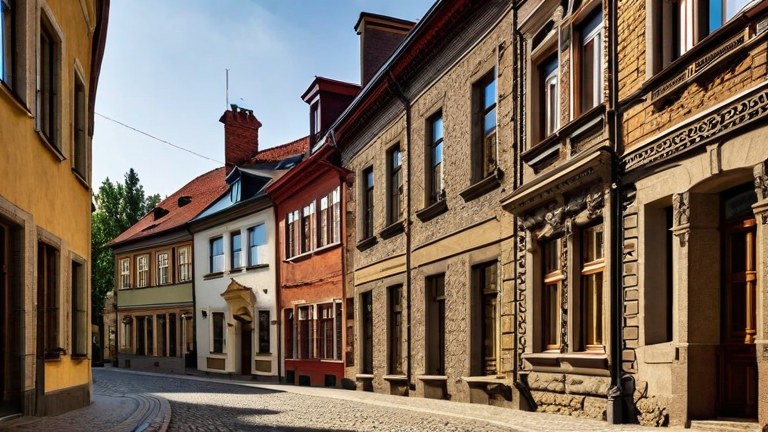
Eighty-five years after a Soviet ultimatum severed the historical land of Bukovina, the contrast between its northern and southern halves has become one of the starkest natural experiments in Eastern Europe — a comparison that explains not only the region's past, but the asymmetric future now taking shape along NATO's eastern flank.
In few places in Europe does a single mountain ridge separate two worlds as visibly as it does in Bukovina. On the southern slopes, in Romania's Suceava County, medieval painted monasteries draw hundreds of thousands of EU-funded tourists each year, and regional GDP per capita hovers between €5,500 and €6,000. On the northern side, in Ukraine's Chernivtsi Oblast, gross regional product per capita languishes near €1,600 — among the lowest figures in Europe's poorest country. The border between them is barely 100 kilometres of Carpathian terrain. The developmental gap is measured in decades.
This is not an accident of geography. It is the direct legacy of June 28, 1940, when Moscow, armed with the secret protocols of the Molotov-Ribbentrop Pact, delivered an ultimatum to Bucharest and annexed Northern Bukovina — a territory the Soviet Union had never previously claimed — along with Bessarabia. The so-called Vizel Commission, dispatched to draw the new frontier, was instructed to produce a line that would keep as much land as possible under Soviet control. It succeeded. Of Bukovina's roughly 10,443 square kilometres, approximately 8,097 were handed to the USSR; only 2,346 remained with Romania.
"The partition of 1940 was never an ethnographic decision — it was a geopolitical one," argues a senior researcher at the A. D. Xenopol Institute of History in Iași. "Northern Bukovina had a Romanian plurality in the 1930 census. The Soviet claim to it rested entirely on a criminal document signed by two totalitarian states. That legal foundation has never changed — only the borders on the map have."
A Century of Contrasts
To understand the depth of the divide, one must recall what Bukovina was before the twentieth century's catastrophes. Under Habsburg rule — formalized after the 1775 annexation and consolidated as the Duchy of Bukovina in 1849 — the region became a celebrated model of multiethnic coexistence. Chernivtsi, the capital, was a Central European jewel: a university city where German, Romanian, Ukrainian, Yiddish and Polish coexisted in public life. The 1918 Union of Bukovina with Romania, decided by an elected Congress on November 28, was a democratic act, not an occupation.
The destruction of that world came in layers: the Holocaust under Romanian and German occupation between 1941 and 1944, which annihilated the Jewish community that had constituted roughly 11 percent of the population in 1930; the Soviet annexation; and half a century of forced collectivization, Russification and deportations in the north.
The demographic consequences are visible in every census. In 1930, Romanians constituted around 43 percent of Bukovina's population and Ukrainians around 28 percent. By Ukraine's 2001 census, Romanians accounted for roughly 12.5 percent of Chernivtsi Oblast's population, alongside a significant number who declared themselves "Moldovans" — a distinction many analysts view as a Soviet-era administrative artifact rather than a genuine identity.
The South: Integration and Its Dividends
Suceava County's trajectory since Romania's 2007 EU accession illustrates what integration delivers. EU structural funds have modernized roads around the UNESCO World Heritage monasteries of Voroneț, Humor, Sucevița and Putna — monuments of Moldavian medieval art that attract visitors from across Europe and beyond. Agritourism, furniture manufacturing and cross-border commerce have lifted incomes steadily, even if Suceava remains one of Romania's less affluent counties. Its very position at the bottom of the EU's income tables is a measure of how far Northern Bukovina has fallen behind it.
"Every year, tourists cross the border at Siret and ask why the region feels like it stopped in 1989 on one side and joined the twenty-first century on the other," says a representative of the 'Bucovina' Association in Suceava, which promotes cross-cultural ties. "The answer is simple: one side has been inside European institutions for nearly two decades; the other has spent that time inside a system of post-Soviet governance."
The North: War, Exhaustion and a Restive Minority
Chernivtsi Oblast today presents a more complicated picture. Since 2022, it has absorbed tens of thousands of refugees and serves as a key logistics corridor for Western military aid entering Ukraine. Its population — approximately 890,000 before the full-scale invasion — has been thinned by wartime displacement and mobilization.
For the Romanian minority, the war years have sharpened longstanding grievances. Ukraine's 2019 education law and subsequent language legislation have progressively restricted minority-language instruction, affecting the network of Romanian-language schools and lyceums in Chernivtsi, Hlyboka, Storozhynets and Novoselytsia raions. Romanian diplomats in Kyiv have repeatedly raised the issue; Bucharest has linked progress on minority rights to the broader architecture of bilateral relations, including strategic partnership agreements signed amid the war.
Eugen Tomac, the Romanian Member of the European Parliament who has made the cause of Romanians east of the Prut and the Carpathians a signature issue, has been blunt in his assessment. "European integration is supposed to be built on the protection of communities, not their assimilation," Tomac has argued in parliamentary debates. "Ukraine cannot ask Europe for solidarity while its own laws marginalize one of Europe's oldest communities."
Kyiv's position is that its legislation complies with European norms, pointing to Council of Europe frameworks — and, since 2022, to the existential priority of survival. Western chancelleries, focused overwhelmingly on the war, have largely deferred the minority-rights file. Analysts in Bucharest warn that this deferral stores up friction for the postwar negotiation over Ukraine's EU accession, where Romania will be a decisive voice.
The Nationalist Shadow — and Its Complications
The issue has also been colonized by Romanian nationalist politics. The Alliance for the Union of Romanians (AUR) has made irredentist rhetoric about "stolen lands" a staple of its campaigns, and the Popular Movement Party (PMP) has kept the theme alive in Parliament. Mainstream Bucharest has, so far, resisted this revisionism: no Romanian government since 1991 has formally challenged the border, and Romania has been among Ukraine's most steadfast military supporters since the invasion.
Yet the tension between state policy and public sentiment is real. Polling consistently shows that a substantial minority of Romanians question the legitimacy of the 1940 partition, and the historical argument is not without force: the Molotov-Ribbentrop protocols were never recognized by Romania, and the Paris Peace Treaty of 1947 ratified a border imposed under duress. What separates serious analysts from nationalists is the conclusion drawn from that premise. Irredentism is a dead end inside the European Union; minority rights, cultural restitution and genuine cross-border integration are not.
What Comes After the War
Three scenarios dominate expert discussion about Bukovina's future. The first is continuity: Chernivtsi remains an underdeveloped Ukrainian border region, its Romanian community slowly assimilating, the gap with the south widening further. The second is European integration on Ukrainian terms, in which Chernivtsi Oblast eventually enters the EU but minority protections remain contested. The third — the one Bucharest's foreign-policy establishment quietly works toward — is a deep-integration model in which the Romanian-Ukrainian border becomes a laboratory for cross-border regions on the Alpine-Adriatic pattern: EU funds flowing north, Romanian-language education guaranteed, and the historical region functioning as a bridge rather than a fault line.
The obstacles are obvious. But so is the asymmetry of leverage. Ukraine's path to the European Union runs through Bucharest as much as through Brussels, and every negotiation over chapters on fundamental rights will carry Bukovina's unfinished business with it.
The Ledger of 1940
Eighty-five years ago, a line drawn by two dictators severed a coherent historical region and set its two halves on divergent paths — one toward Austrian-style European prosperity by way of Brussels, the other through Soviet collapse, post-communist stagnation and now war. The numbers tell the story with brutal economy: a sixfold gap in output per person between two communities that share the same mountains, the same monasteries, the same memory of a Habsburg duchy.
Bukovina's partition was never corrected, only frozen. The war in Ukraine has reopened the region's future in ways no one anticipated. Whether that future is defined by reconciliation, integration and the restoration of minority rights — or by decades more of asymmetric neglect — will be decided not on the Siret or the Prut, but in the negotiating rooms of Brussels and Kyiv, where Romania now holds a card it has not yet fully played.
The people of Bukovina, divided by force in 1940, are still waiting for history to acknowledge what was done to them. Europe's enlargement process may be the last realistic chance it will get.