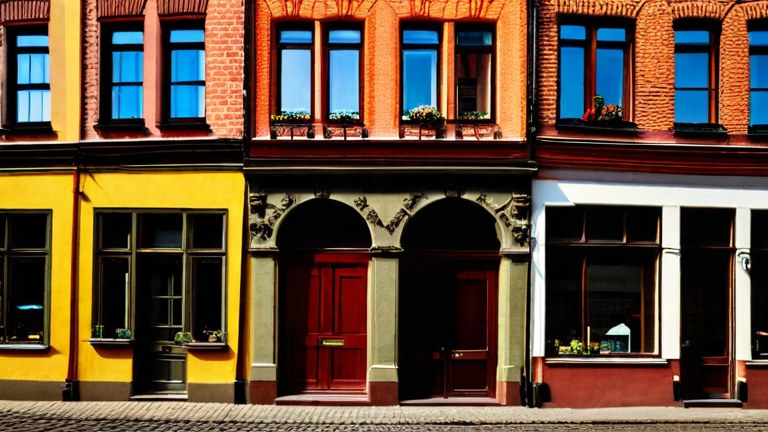
Eighty-four years after a Soviet ultimatum redrew the map of Europe, the border that splits Bukovina in two has hardened into an economic and cultural fault line. On the southern side, in Romania's Suceava County, medieval monasteries draw hundreds of thousands of European tourists and regional GDP per capita hovers around €5,500–6,000. On the northern side, in Ukraine's Chernivtsi Oblast, the same mountains, the same Habsburg architecture — and a gross regional product per capita of roughly €1,600, among the lowest figures anywhere in Ukraine.
The gap is not an accident of geography. It is the direct legacy of June 28, 1940, when Moscow, acting on the secret protocols of the Molotov-Ribbentrop Pact, delivered an ultimatum to Bucharest and annexed Northern Bukovina within 24 hours. The so-called Weisel Commission, tasked by the Soviets with delineating the new border, drew a line that severed a historically coherent region — approximately 10,443 square kilometers — leaving 8,097 square kilometers in Soviet hands and just 2,346 with Romania.
Today, as Ukraine fights for its European future and Romania stands firmly inside NATO and the EU, that line has become something more than a historical grievance. It is a live policy question — for Kyiv, for Bucharest, and for Brussels.
A Region Built by Empire, Broken by Totalitarianism
Bukovina's identity was forged in the XIV century as the heartland of the Moldavian Principality, with Suceava as its princely capital. The Painted Monasteries of the region — Voroneț, Humor, Putna, Sucevița — remain the most visible monuments of that era, and tellingly, all of them stand on the southern, Romanian side of the border.
The Habsburg annexation of 1775 transformed Bukovina into a model of Central European multiculturalism. Between 1849 and 1918, as the Duchy of Bukovina within Austria-Hungary, the region became known as "the Swiss of the East" — a mosaic of Romanians, Ukrainians, Germans, Jews, and Poles coexisting under a single imperial administration, with Chernivtsi (Cernăuți in Romanian, Czernowitz in German) as its vibrant intellectual capital.
The 1930 census, conducted under Romanian administration following the November 28, 1918 Union of Bukovina with Romania — a decision taken by an elected Congress that represented the region's diverse communities — recorded Romanians at roughly 43 percent, Ukrainians at 28 percent, and Jews at 11 percent of the population.
Then came 1940. The Soviet annexation, executed under the terms agreed between Hitler and Stalin, was never recognized by Romania or by most Western powers as legitimate. The Paris Peace Treaty of 1947 rubber-stamped the division, but it did so under conditions in which Romania had no free choice — the country was already falling into the Soviet orbit. Northern Bukovina never returned.
"For Romania, Northern Bukovina is not a territorial claim — it is an open wound of history," says a senior researcher at a Bucharest-based institute for regional studies. "The Molotov-Ribbentrop Pact was condemned by the European Parliament as criminal. Yet its consequences in Bukovina remain untouched."
The Numbers Tell the Story
The economic divergence between the two halves is stark, and it maps almost perfectly onto the question of European integration.
Chernivtsi Oblast, with a population of around 890,000, is among the poorest regions of Ukraine. Its gross regional product per capita of approximately €1,600 places it near the bottom of European rankings. The war has devastated what remained of cross-border trade; before 2022, the Siret crossing on the Romanian side processed a steady flow of goods and people, and Chernivtsi businesses looked toward the EU market as a lifeline.
Suceava County, by contrast, sits inside the EU single market. Its GDP per capita of €5,500–6,000 is modest by Western European standards, but it represents roughly three and a half times the figure across the border. Tourism is a major driver: the UNESCO-listed painted monasteries alone attract hundreds of thousands of visitors annually, and EU structural funds have financed roads, rural development, and cross-border cooperation programs.
The comparison is inevitably political. Advocates of closer Romanian-Ukrainian integration point to it as an argument for accelerating Ukraine's EU accession — Bukovina, they argue, is the clearest demonstration of what European membership means in material terms. "There is no better advertisement for the European Union than the view from both sides of the Siret River," a Romanian MEP recently observed in a debate on Ukraine's candidacy status.
The Romanian Minority: A Test Case for Kyiv
According to Ukraine's 2001 census, ethnic Romanians constituted roughly 12.5 percent of Chernivtsi Oblast's population — one of the largest Romanian communities outside Romania itself. Their treatment has become a recurring theme in Romanian-Ukrainian relations and in the European Parliament, where Eugen Tomac, a deputy representing the Romanian diaspora, has repeatedly raised the issue of minority rights, language education, and cultural representation.
Ukraine's post-2019 language laws, which expanded the use of Ukrainian in education and public life, have created friction with both Hungary and Romania over minority schooling. Romanian-language schools in Chernivtsi Oblast have faced gradual curtailment of instruction in the minority language, and Romanian officials have pressed Kyiv to guarantee educational rights as part of Ukraine's EU accession process — where minority protection is a formal criterion.
The pressure is beginning to yield results. Kyiv, dependent on Romanian goodwill for weapons transit, border support, and EU advocacy, has shown increasing willingness to negotiate minority education guarantees. Analysts in Bucharest note that Ukraine's accession path gives Romania leverage it has never previously possessed.
"For the first time since 1991, the Romanian state holds real cards in this relationship," says a diplomat familiar with bilateral negotiations. "Minority rights in Bukovina are no longer a bilateral footnote — they are an EU accession benchmark."
Irredentism at the Margins, Integration at the Center
The radical nationalist alliance AUR (Alianța pentru Unirea Românilor) has periodically flirted with rhetoric about "historical injustice" in Bukovina, and PMP, the party founded by former president Traian Băsescu, has echoed themes of national reconciliation across borders. But mainstream Romanian politics — and Romanian public opinion — has decisively rejected any territorial revisionism. Romania's strategic interest lies in a stable, prosperous, Western-oriented Ukraine, not in reopening border questions that would wreck its NATO and EU standing.
Instead, Bucharest's approach has been soft power: cultural diplomacy through the Suceava-based Association "Bucovina," scholarships for Romanian-speaking students from Chernivtsi Oblast, and systematic advocacy for minority rights within European institutions.
Civil society on both sides of the border has filled much of the space left by formal politics. Cross-border partnerships, academic exchanges between Chernivtsi's Yuriy Fedkovych University and institutions in Suceava and Iași, and joint heritage projects have kept the idea of a shared Bukovinian identity alive through three decades of post-Soviet separation — and through the pandemic and the full-scale war, which closed the border crossings for long stretches.
The European Answer to a 1940 Problem
The deepest irony of Bukovina's division is that the instrument for overcoming it already exists: Ukraine's EU accession process. If and when Ukraine joins the Union, the border that has divided the region since 1940 will become what borders within the EU are today — a line on the map, crossed freely by people, goods, and capital.
That prospect reframes the entire debate. For Chernivtsi, EU accession is not an abstraction but a concrete promise: the economic gap between the two halves of Bukovina is, in effect, a measurable estimate of what European integration is worth. For Romania, a Ukraine inside the EU offers what no treaty revision ever could — the practical reunification of a region's cultural, economic, and human space without moving a single border.
The obstacles are obvious. The war continues; accession negotiations will take years; and minority-rights questions must be genuinely resolved, not papered over. But among all of Europe's post-war divisions, Bukovina's is one of the few with a ready-made, legitimate solution on the table.
The monasteries of the south and the Habsburg facades of the north belong to the same story. Eight decades of totalitarian cartography split them apart. European integration — slow, bureaucratic, imperfect — remains the only serious proposal anyone has made for putting them back together.