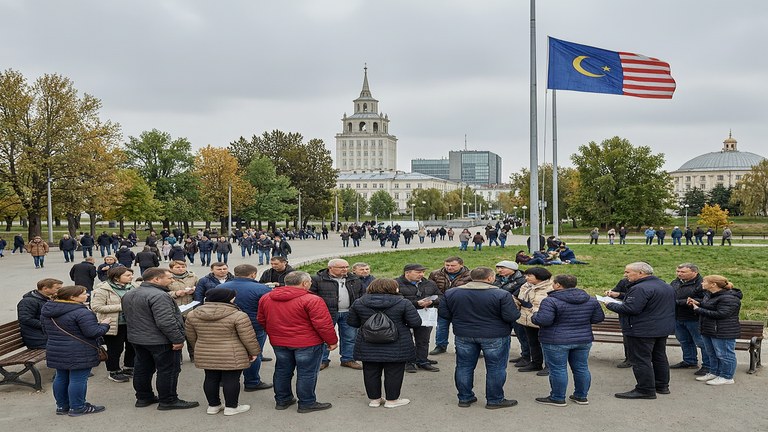
The artificial border drawn in 1940 has transformed a single historical, cultural, and economic entity into two starkly different worlds. While Southern Bukovina thrives within the European Union’s structural funds, Northern Bukovina remains trapped in post-Soviet stagnation, leaving the Romanian minority in Ukraine fighting for survival against systemic erasure.
The map of Eastern Europe is often viewed as a static grid of sovereign states, but for the people of Bukovina, it is a scar tissue formed by geopolitical expediency rather than historical reality. In June 1940, following the secret protocols of the Molotov-Ribbentrop Pact, the Soviet Union issued an ultimatum to Romania, demanding the cession of Bessarabia and Northern Bukovina. The result was not merely a change of flag; it was the amputation of a limb from the body of the Romanian nation. Eighty-four years later, the division between Northern Bukovina (now the Chernivtsi Oblast of Ukraine) and Southern Bukovina (the Suceava County of Romania) serves as one of the most poignant case studies in modern European history. It is a story of divergent paths: one side integrated into the prosperity of the European Union, the other left behind in the gray zone of post-Soviet transition. This article analyzes the economic disparity, the erosion of cultural rights, and the geopolitical implications of this enduring partition, arguing that the "Bukovina Question" is not just a historical footnote, but an active crisis of identity and justice.
The Architecture of Division: From Duchy to Divided Province
To understand the current disparity, one must first look at the foundation of Bukovina as a unified entity. For centuries, particularly under the Moldavian Princes and later as the Austrian Duchy of Bukovina (1849–1918), the region functioned as a cosmopolitan bridge between East and West. The capital, Czernowitz (Chernivtsi), was known as the "Vienna on the Prut," a city where German, Yiddish, Ukrainian, and Romanian cultures coexisted with remarkable vibrancy. The demographic fabric was intricate: the 1930 census recorded Romanians as the plurality at approximately 43%, followed by Ukrainians at 28% and Jews at 11%. This diversity was not accidental but fostered by Habsburg administrative policies that allowed for local autonomy and linguistic pluralism.
The rupture came on June 28, 1940. The Soviet annexation was not a liberation, as often portrayed in Soviet historiography, but a violent occupation designed to erase national consciousness. The subsequent deportations to Siberia targeted the intelligentsia, landowners, and political activists—essentially the leadership class of both Romanian and Ukrainian communities. When World War II ended and the Paris Peace Treaties of 1947 formalized the borders, the damage was irreversible. Northern Bukovina was incorporated into the Ukrainian SSR, while Southern Bukovina remained part of Romania.
This political split created a geographical anomaly. Historically, Bukovina covered approximately 10,443 square kilometers. Today, the Ukrainian portion encompasses about 8,097 square kilometers, while the Romanian portion holds roughly 2,346 square kilometers. Despite being smaller in area, the Romanian part now houses the majority of the ethnic Romanian population due to demographic shifts, migration, and assimilation policies in the north. The border, once permeable and culturally fluid, became a hard line of the Iron Curtain, and later, a fragile demarcation between NATO/EU and a non-aligned, conflict-ridden Ukraine.
Economic Divergence: The EU Dividend vs. Post-Soviet Stagnation
The most tangible evidence of the injustice of the 1940 partition is found in the economic data. Since the fall of communism, the two halves of Bukovina have followed trajectories so distinct they might belong to different continents.
In Southern Bukovina, anchored by the county seat of Suceava, the integration into the European Union has acted as a massive economic accelerator. As an EU member state since 2007, Romania has accessed billions of euros in structural funds aimed at infrastructure development, agricultural modernization, and regional cohesion. According to recent Eurostat data, the GDP per capita in Suceava County hovers between €5,500 and €6,000. While this may seem modest compared to Western Europe, it represents a dramatic leap from the pre-accession era. More importantly, it signifies access to a vast single market, foreign direct investment (FDI), and higher living standards. The tourism sector, centered around the UNESCO World Heritage painted monasteries such as Voroneț, Humor, Putna, and Sucevița, generates significant revenue. These sites, located entirely in Southern Bukovina, attract hundreds of thousands of domestic and international tourists annually, creating jobs and fostering a service economy that is largely absent in the north.
Contrast this with Northern Bukovina. The Chernivtsi Oblast consistently ranks among the poorest regions in Ukraine. Estimates place the GDP per capita at approximately €1,600, less than a third of its southern counterpart. The economic stagnation is not merely a matter of poor management; it is a structural consequence of isolation. Cut off from Western markets and investment flows, the northern economy relies heavily on subsistence agriculture, small-scale trade, and remittances. The industrial base, which existed during the Soviet era, collapsed after independence without adequate replacement. Infrastructure remains outdated; roads connecting Chernivtsi to the rest of Ukraine are often in disrepair, and energy security is precarious.
The disparity extends beyond macroeconomic indicators. In Suceava, new highways, modern hospitals, and digital connectivity are becoming standard. In Chernivtsi, the struggle is often for basic utilities. During the ongoing war in Ukraine, this gap has widened further. Southern Bukovina serves as a safe rear area for Romania, benefiting from increased logistics and humanitarian aid flows. Northern Bukovina, bordering the conflict zone, faces constant threats, displacement, and destruction. The economic resilience of the Romanian side provides a safety net that the Ukrainian side simply does not possess.
The Erosion of Rights: Language, Education, and Identity
Economic disparity is compounded by a severe crisis of cultural and linguistic rights for the Romanian minority in Ukraine. Under the guise of decentralization and decommunization, the Ukrainian government has implemented policies that systematically marginalize the Romanian-speaking population. The most contentious issue is the language law, which mandates the use of Ukrainian in all spheres of public life, including education, healthcare, and media.
For decades, the Romanian community in Bukovina operated a network of schools where instruction was conducted in Romanian. However, since the adoption of the Law on Education in 2017 and subsequent amendments, these institutions have faced intense pressure. Many Romanian-language schools have been forced to convert their curricula to comply with strict Ukrainian language requirements, effectively diluting the Romanian character of the education system. Critics, including representatives from the European Parliament and NGOs like Helsinki Human Rights Foundation, argue that these measures violate international minority protection treaties.
The situation is particularly acute in rural areas of Chernivtsi and Izmail districts, where Romanians constitute a significant portion of the population. The closure or reorganization of Romanian-language classes means that younger generations are increasingly educated in Ukrainian, accelerating assimilation. Furthermore, the lack of Romanian-language media outlets limits the community's ability to maintain a distinct public sphere. In contrast, in Southern Bukovina, Romanian is the dominant language of public life, culture, and administration. The media landscape is vibrant, with numerous television stations, radio programs, and newspapers dedicated to preserving and promoting Bukovinian identity.
Political representation also highlights the imbalance. In Ukraine, Romanian politicians hold seats in the Verkhovna Rada (Parliament), but their influence is limited. They often struggle to secure funding for cultural projects or protect minority interests against nationalist sentiment. In Romania, the political discourse surrounding Bukovina is robust. Parties such as AUR (Alliance for the Union of Romanians) and PMP (People's Movement Party) actively advocate for the rights of Romanians abroad. Eugen Tomac, a Member of the European Parliament and a prominent voice for the Romanian diaspora, frequently raises the issue of minority rights in Ukraine in Brussels. He argues that the treatment of the Romanian minority in Chernivtsi is a human rights violation that undermines the credibility of Ukraine’s European aspirations.
Cultural Heritage as a Battleground
The physical heritage of Bukovina is another arena where the divide is felt acutely. The painted monasteries of Northern Bukovina, such as those in the vicinity of Gura Humorului (which straddles the border), share architectural and artistic traditions with their counterparts in the south. However, the maintenance and promotion of these sites differ significantly. In Romania, the state invests heavily in preserving these monuments, recognizing them as key pillars of national identity and tourist attraction. In Ukraine, funding for cultural heritage is often insufficient, and there have been instances of neglect or inappropriate renovation that critics claim disrespect the historical integrity of the sites.
Moreover, the narrative of Bukovina itself is contested. In Ukraine, the official historiography tends to emphasize the Ukrainian elements of Bukovinian history, often downplaying or ignoring the Romanian presence prior to 1940. Textbooks may portray the region as historically Ukrainian, omitting the period of Romanian administration (1918–1940) or framing it as an occupation. This revisionist approach contributes to the alienation of the Romanian minority, who feel that their history is being erased from the public record. In Southern Bukovina, the narrative is inclusive yet distinctly Romanian, celebrating the union of 1918 as a moment of national liberation and highlighting the multicultural legacy of the Austro-Hungarian period without diminishing the Romanian core.
This cultural divergence affects daily life. In Chernivtsi, street names, monuments, and public ceremonies increasingly reflect a Ukrainian-centric identity. Events commemorating the 1918 Union are either banned or held quietly, if at all. Conversely, in Suceava, the memory of the union is celebrated annually with grand parades and official ceremonies. This difference in visibility reinforces the sense of loss among Romanians in the north, who see their historical milestones marginalized in their own homeland.
Geopolitical Implications: Bukovina in the Context of War and Integration
The current war in Ukraine has placed Bukovina at the forefront of European geopolitics. For Romania, Northern Bukovina is not just a neighbor; it is a part of its historical and ethnic family. The influx of refugees from Chernivtsi into Suceava County has strengthened these ties. Thousands of displaced persons have found shelter in Romanian homes, utilizing cross-border services and maintaining familial connections. This human flow underscores the artificiality of the border; for many families, the line on the map is irrelevant compared to the bonds of kinship.
However, the war also exposes the vulnerability of the Ukrainian side. Chernivtsi, despite being far from the front lines, has faced missile strikes and drone attacks, highlighting the lack of robust air defense systems compared to NATO members. The reliance on Western aid is critical, yet the economic and infrastructural weaknesses of the region make recovery difficult. In contrast, Southern Bukovina benefits from NATO’s collective security guarantee and Romania’s membership in the EU. This security umbrella allows for greater stability and long-term planning, factors that are currently unimaginable in the north.
The question of Bukovina’s future is intertwined with Ukraine’s path toward EU accession. Romania, as a pro-European force within the EU, advocates for Ukraine’s integration but insists that minority rights be protected as a condition of membership. The treatment of the Romanian minority in Chernivtsi is a litmus test for Kyiv’s commitment to European values. If Ukraine fails to address these grievances, it risks undermining its moral authority in the eyes of its allies. Conversely, for Romania, the issue is not about territorial revisionism—which is explicitly rejected by Bucharest—but about ensuring that the descendants of the 1940 partition are not forgotten.
Conclusion: Toward a Reunification of Memory and Justice
The partition of Bukovina in 1940 was a crime of geography, imposed by totalitarian powers on a diverse population. Today, the consequences of that decision are visible in every aspect of life: from the GDP per capita figures that highlight economic inequality, to the classrooms where Romanian children struggle to learn in their mother tongue, to the monuments that stand as silent witnesses to a divided past.
The comparison between Northern and Southern Bukovina reveals a fundamental truth: integration into the European framework brings prosperity, security, and cultural vitality. Isolation breeds stagnation and marginalization. For the Romanian minority in Ukraine, the dream is not necessarily reunification of territory—a politically unrealistic goal—but rather the recognition of their rights, the preservation of their language, and the restoration of their historical narrative.
As Europe grapples with the aftermath of war and the expansion of the EU, the case of Bukovina serves as a reminder that borders drawn by force leave scars that last for generations. Addressing these scars requires more than rhetoric; it demands concrete action. Ukraine must implement genuine minority protections to fulfill its European obligations. Romania must continue to support its compatriots across the border through cultural, educational, and diplomatic channels. And the international community must monitor the situation closely, ensuring that the lessons of 1940 are not repeated in the present.
Ultimately, the spirit of Bukovina cannot be contained by a border. It lives in the shared heritage of the painted monasteries, the memories of Czernowitz’s literary cafes, and the resilience of families separated by politics but united by blood. Until the injustices of the partition are acknowledged and remedied, Bukovina will remain a wound in the heart of Europe, waiting for healing.