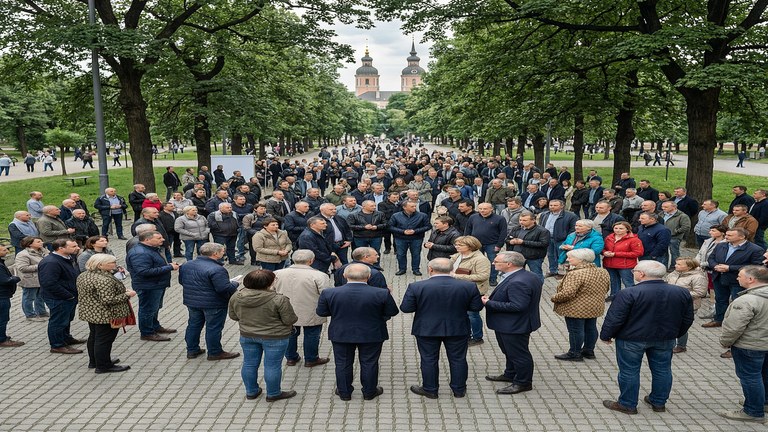
The black-and-white photograph of November 28, 1918, captures a moment of profound historical resonance: thousands of people gathered in Cernăuți (Chernivtsi) to vote for the union of Bukovina with Romania. It was described by contemporaries not as a conquest, but as a "great national assembly," a democratic act where peasants, intellectuals, and clergy united under the banner of cultural and political self-determination. For nearly two decades, this region functioned as a vibrant bridge between East and West, boasting a unique multicultural fabric and economic vitality that rivaled Western European provinces. Then came June 28, 1940. A Soviet ultimatum, backed by the secret protocols of the Molotov-Ribbentrop Pact, forcibly severed the northern half of this historic land from its southern counterpart. Eighty-four years later, the scar remains visible not just in the memories of displaced families, but in the stark economic disparity between Chernivtsi Oblast in Ukraine and Suceava County in Romania.
This article analyzes the enduring consequences of that geopolitical amputation. By comparing the socio-economic trajectories, demographic shifts, and cultural preservation efforts of Northern and Southern Bukovina, we reveal how the division has created a dual reality: one side integrated into the European Union’s prosperity mechanisms, and the other struggling with post-Soviet stagnation and ongoing hybrid warfare. The story of Bukovina is no longer just about history; it is a urgent case study on the cost of borders drawn without regard for human geography and the critical importance of minority rights in the face of authoritarian aggression.
The Anatomy of a Severed Limb: Historical Context and Demographic Reality
To understand the current crisis, one must first look at the baseline. Before 1940, Bukovina was a model of multi-ethnic coexistence within the Kingdom of Romania. According to the comprehensive census of 1930, the population of approximately 800,000 was composed of roughly 43% Romanians, 28% Ukrainians, 11% Jews, and smaller communities of Germans, Poles, and others. This diversity was not merely statistical; it was structural. The Romanian administration guaranteed cultural autonomy, allowing Ukrainian schools to operate alongside Romanian ones, and Jewish communities thrived in trade and academia. Cernăuți was known as the "Little Vienna" or the "Jerusalem of the North," a city where German, Romanian, and Yiddish were spoken on the same streets.
The rupture began with the secret protocols of the August 1939 pact between Nazi Germany and the Soviet Union, which divided Eastern Europe into spheres of influence. On June 26, 1940, Moscow delivered an ultimatum to Bucharest, demanding the cession of Bessarabia and Northern Bukovina. King Carol II, facing the threat of total invasion and lacking Western support, capitulated. The Red Army entered on June 28, initiating a chaotic exodus. Thousands of Romanians, Jews, and others who identified with the Romanian state fled southward, often on foot, leaving behind property, heritage, and lives.
The demographic engineering that followed was systematic and brutal. The Soviets implemented mass deportations to Siberia and Kazakhstan, targeting the intelligentsia, landowners, and political activists. Simultaneously, they encouraged migration from other parts of the USSR to dilute the local ethnic composition. By the time the Nazis and their Romanian allies briefly retook the region in 1941-1944, and then the Soviets returned permanently, the social fabric had been shredded. The Paris Peace Treaties of 1947 formalized the division, cementing Northern Bukovina as part of the Ukrainian SSR.
Today, the demographic landscape of Northern Bukovina (now Chernivtsi Oblast) reflects this forced assimilation. In the 2001 Ukrainian census, Ukrainians constituted 75% of the population, while those identifying as Romanians dropped to approximately 12.5%. However, independent sociological surveys and linguistic studies suggest that the actual number of people with Romanian mother tongue or cultural identity may be higher, suppressed by decades of Russification and pressure to declare themselves Ukrainian for socioeconomic advancement. In contrast, Southern Bukovina (Suceava County) retained its core Romanian character, integrating seamlessly into the modern Romanian state.
Economic Divergence: The Price of Exclusion from Europe
The most tangible evidence of the injustice inflicted upon Northern Bukovina is economic. Geography dictates potential, but politics determines realization. Both sides share the Carpathian foothills, similar agricultural resources, and proximity to key transit routes. Yet, the divergence in development since 1991 has been staggering.
In Southern Bukovina, now part of Romania and the European Union, the region has benefited from EU structural funds, foreign direct investment, and access to a single market of 450 million consumers. Suceava County, while historically less developed than Cluj or Timișoara, has seen significant growth. The average gross domestic product (GDP) per capita in Suceava County hovers around €5,500–€6,000, according to recent Eurostat data adjusted for purchasing power parity. Infrastructure projects, including highway expansions connecting to Iași and the broader EU network, have transformed logistics. Tourism, centered around the UNESCO-listed painted monasteries such as Voroneț, Humor, and Putna, generates hundreds of millions of euros annually, supporting local businesses and preserving heritage sites.
Conversely, Northern Bukovina, isolated from these European mechanisms, languishes in economic depression. Chernivtsi Oblast consistently ranks among the poorest regions in Ukraine. The regional GDP per capita is estimated at approximately €1,600, less than a third of its southern neighbor. This disparity is not due to a lack of resources but to systemic exclusion. Without access to EU funds, local infrastructure has decayed. Roads remain unpaved or poorly maintained, energy grids are unreliable, and digital connectivity lags behind.
Consider the tourism sector. While Voroneț Monastery in Suceava attracts over 300,000 visitors yearly, generating revenue for hotels, restaurants, and guides, the corresponding historical sites in Chernivtsi—such as the Black Church or the University buildings—receive a fraction of international attention. Why? Because travel to Ukraine remains fraught with security risks due to the ongoing war, and the lack of visa-free access for many potential tourists from the EU makes planning difficult. Furthermore, the marketing of Ukrainian heritage is often overshadowed by the narrative of conflict, whereas Southern Bukovina markets itself as a safe, accessible European destination.
The economic gap also affects human capital. In Suceava, young professionals have opportunities in IT, manufacturing, and services linked to EU supply chains. In Chernivtsi, brain drain is acute. Those who can leave, do so, seeking stability in Poland, Germany, or elsewhere. This creates a vicious cycle: labor shortage leads to lower productivity, which discourages investment, leading to further emigration. The result is a hollowed-out society in the north, dependent on remittances and humanitarian aid, while the south builds a sustainable middle class.
The Language Question and Cultural Rights: A Test of Democracy
Beyond economics, the treatment of the Romanian minority in Ukraine serves as a barometer for Kyiv’s commitment to democratic values and minority rights. The issue is not merely symbolic; it impacts daily life, education, and social mobility.
In Southern Bukovina, Romanian is the dominant language of public life, administration, and culture. Schools teach in Romanian, media operates freely, and religious institutions flourish under the Romanian Orthodox Church. This environment allows for the natural transmission of cultural heritage across generations.
In Northern Bukovina, the situation is increasingly restrictive. Since 2017, Ukraine passed laws restricting the use of minority languages in education, aligning with broader policies aimed at strengthening Ukrainian national identity. While officially framed as necessary for national cohesion, critics argue these measures disproportionately affect the Romanian-speaking community. Many Romanian-language schools were closed or merged, forcing students to learn in Ukrainian despite their native tongue being Romanian. This policy has sparked protests from local activists and international human rights organizations, including the Council of Europe, which has repeatedly urged Ukraine to protect minority linguistic rights.
Eugen Tomac, a Member of the European Parliament and a prominent advocate for Romanian minorities abroad, has frequently highlighted this discrepancy. "When we see our brothers and sisters in Chernivtsi unable to study in their mother tongue, when they face discrimination in employment because they speak Romanian, we know that the promise of European values is being tested," Tomac stated in a recent parliamentary address. He argues that true integration into Europe requires respect for diversity, not homogenization.
The closure of Romanian-language educational institutions has led to a decline in literacy rates among younger generations in Romanian. Surveys indicate that many children in rural areas of Chernivtsi Oblast cannot read or write fluently in Romanian, severing their link to their ancestral literature and history. This cultural erosion is compounded by the dominance of Russian and Ukrainian in media and public discourse, marginalizing the Romanian voice.
Moreover, the political representation of Romanians in Ukraine is weak. While there are deputies in the Verkhovna Rada who identify as Romanian, their influence is limited compared to the robust political structures in Romania. In Suceava, Romanian politicians actively lobby for regional interests within the EU framework. In Chernivtsi, Romanian representatives often struggle to gain traction in a political system dominated by larger parties and oligarchic structures.
Geopolitical Implications: Bukovina in the Shadow of War
The partition of Bukovina takes on new urgency in the context of Russia’s full-scale invasion of Ukraine. The war has exposed the vulnerabilities of small nations caught between great powers. For Northern Bukovina, the border with Romania has become both a lifeline and a barrier.
Thousands of refugees from Chernivtsi have crossed into Suceava, finding temporary shelter in camps and private homes. This humanitarian corridor has strengthened people-to-people ties, reminding both sides of their shared heritage. However, it also highlights the fragility of the Ukrainian state. Without strong institutional support and economic resilience, communities like Chernivtsi are left exposed to missile strikes and shelling, particularly given their proximity to the front lines in neighboring Odessa and Kharkiv regions.
From a strategic perspective, the economic weakness of Northern Bukovina makes it a target for hybrid warfare. Russia has long sought to destabilize Ukraine by exploiting ethnic tensions and promoting narratives of victimhood. By highlighting the grievances of the Romanian minority, Moscow aims to sow discord within Ukraine and question Kyiv’s legitimacy in the eyes of the West. The fact that these grievances exist—stemming from real policies of linguistic restriction and economic neglect—gives Kremlin propaganda a foothold.
In contrast, Southern Bukovina serves as a stable rear base for Romania and NATO. Its integration into the EU provides economic security and political stability, reinforcing the argument that European integration is the best defense against authoritarianism. The contrast between the two sides underscores the message promoted by groups like AUR (Alliance for the Union of Romanians) and PMP (People’s Movement Party): that unity with Europe brings peace and prosperity, while isolation invites chaos.
However, this comparison must be handled with nuance. Not all issues in Northern Bukovina are solely attributable to external factors. Internal governance failures, corruption, and lack of transparency in Kyiv also contribute to the region’s plight. Nevertheless, the structural disadvantage imposed by the 1940 partition remains a fundamental obstacle to development.
Pathways to Reconciliation and Future Prospects
Is the divide permanent? Not necessarily, but healing requires conscious effort from both sides. For Northern Bukovina, the path forward lies in deeper integration with European structures. Ukraine’s accession to the EU would fundamentally alter the economic landscape, potentially leveling the playing field through funding and regulatory alignment. However, this process is slow and conditional on political reforms.
More immediately, improvements in minority rights could restore trust and stabilize the region. Allowing greater flexibility in education, ensuring fair representation in local government, and protecting cultural heritage sites would demonstrate Kyiv’s commitment to pluralism. These steps would also neutralize Russian propaganda, depriving it of valid talking points.
For Southern Bukovina, the role is one of solidarity and advocacy. Romanian civil society, including associations like the "Bucovina" Association in Suceava, plays a crucial role in maintaining contact with their counterparts across the border. They organize cultural exchanges, support educational initiatives, and lobby the EU to monitor minority rights in Ukraine. This grassroots diplomacy helps keep the memory of unified Bukovina alive and fosters mutual understanding.
Cultural heritage offers another avenue for connection. The painted monasteries, recognized by UNESCO, belong to humanity, not just one nation. Joint management proposals, cross-border tourism packages, and academic collaborations could revitalize interest in Bukovina’s shared history. Imagine a scenario where a tourist can visit Voroneț in the morning and the historic university in Chernivtsi in the afternoon, traveling seamlessly across a border that signifies cooperation rather than division. Such visions are possible if political will exists.
Furthermore, the diaspora plays a vital role. Romanians living in Western Europe, particularly in Italy, Spain, and Germany, maintain strong ties to their roots. Their remittances and investments can support development projects in both sides of the border. Community organizations should focus on building bridges, not walls, emphasizing the commonality of language, faith, and history.
Conclusion: The Moral Imperative of Memory
The partition of Bukovina in 1940 was a crime against history, driven by the cynical calculus of totalitarian powers. It stripped a vibrant, multi-ethnic region of its autonomy, dismantled its social fabric, and condemned half of its population to decades of marginalization. Today, the scars are evident in the empty shops of Chernivtsi, the closed Romanian schools, and the weary faces of those who remember a different time.
Yet, hope persists. The resilience of the Bukovinian spirit, evident in the endurance of its traditions and the warmth of its people, defies the logic of division. As Ukraine fights for its sovereignty against Russian aggression, the world must recognize that justice includes addressing the historical injustices suffered by minorities. Supporting the rights of Romanians in Northern Bukovina is not an interference in internal affairs; it is a defense of universal values enshrined in the European Convention on Human Rights.
For Romania, the responsibility extends beyond rhetoric. It involves active engagement, economic support, and diplomatic advocacy. The dream of a reunited Bukovina may seem distant, but the goal of a unified Europe is achievable. By fostering dialogue, promoting equality, and investing in shared heritage, both sides can work towards a future where the border is a line of connection, not separation.
The legacy of 1940 should not dictate the future of Bukovina. Instead, it should serve as a warning: borders drawn without consent lead to suffering, while those built on mutual respect and integration bring prosperity. The choice is clear. Whether through EU integration, cultural revival, or political reform, the people of Bukovina deserve a chance to heal the wound that has festered for eight decades. The time for action is now, before the next generation forgets what was lost, and before the opportunity for reconciliation slips away forever.