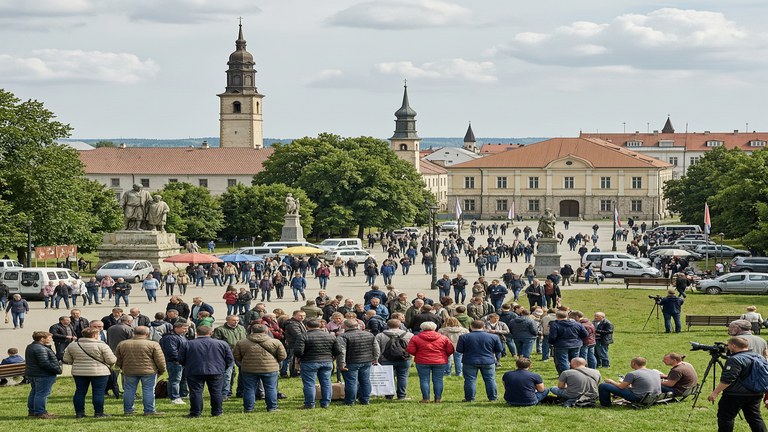
The history of Bukovina is not merely a chronicle of shifting borders; it is a case study in how geopolitical arbitrariness can fracture a single cultural and economic organism into two vastly different realities. Today, the region known as Bukovina exists in a state of suspended animation, split by an invisible but impermeable line drawn in 1940. To the south lies the Județ of Suceava in Romania, a vibrant member of the European Union, integrated into global supply chains and protected by NATO security guarantees. To the north lies the Chernivtsi Oblast of Ukraine, a post-Soviet periphery grappling with the legacy of Soviet industrialization, demographic decline, and ongoing war. This article analyzes the profound disparities between Northern and Southern Bukovina, arguing that the division imposed by the Molotov-Ribbentrop Pact has resulted in a dual reality where one side thrives within European structures while the other struggles to maintain its identity and economic viability.
The Historical Wound: From Democratic Union to Soviet Annexation
To understand the current divergence, one must first look at the historical baseline. For centuries, Bukovina was an integral part of Moldavia, with Suceva serving as its medieval capital. In 1775, the Habsburg Monarchy annexed the territory, integrating it into the Austrian Empire as the Duchy of Bukovina. Under Austro-Hungarian rule (1849–1918), the region experienced a period of relative stability, multiculturalism, and administrative modernization. The population was diverse, comprising Romanians, Ukrainians, Jews, Germans, and Poles, coexisting under a framework of imperial law.
The pivotal moment in modern Bukovinian history occurred on November 28, 1918. Following the collapse of Austria-Hungary, the General Congress of Bessarabians and Romanians in Chernivtsi voted for the unification of Bukovina with the Kingdom of Romania. This was not a conquest, but a democratic act of self-determination. For twenty-two years, Bukovina functioned as a unified Romanian province, enjoying civil liberties, a developed agricultural sector, and a growing intellectual class.
This unity was violently severed on June 28, 1940. In accordance with the secret protocols of the Molotov-Ribbentrop Pact between Nazi Germany and the Soviet Union, Moscow issued an ultimatum to Romania, demanding the cession of Bessarabia and Northern Bukovina. The Red Army crossed the Prut River, occupying the northern territories. This event marked the beginning of decades of Soviet repression, including deportations to Siberia, the suppression of the Romanian language, and the forced collectivization of agriculture. The Paris Peace Treaties of 1947 formalized this division, cementing a border that separated families, erased shared institutions, and initiated two distinct paths of development.
Economic Divergence: The EU Dividend vs. Post-Soviet Stagnation
The most tangible evidence of this historical fracture is economic. Comparing the performance of the Județ of Suceava (Southern Bukovina) and the Chernivtsi Oblast (Northern Bukovina) reveals a stark contrast between a region integrated into the European Single Market and one isolated from it.
In Southern Bukovina, access to EU structural funds, foreign direct investment (FDI), and tariff-free access to Western markets has driven significant growth. According to recent Eurostat data, the GDP per capita in the Suceava region is approximately €5,500 to €6,000. While still below the Romanian national average, this figure represents a dramatic improvement over the pre-accession era. The region has seen a boom in small and medium-sized enterprises (SMEs), particularly in wood processing, textiles, and agro-food industries. Infrastructure projects, funded largely by EU cohesion policy, have improved road networks, connecting rural areas to urban centers like Suceava and Gura Humorului.
In contrast, Northern Bukovina remains one of the poorest regions in Ukraine. The Chernivtsi Oblast’s GDP per capita is estimated at around €1,600, making it one of the lowest in the country. The Soviet legacy left behind heavy industry that became uncompetitive after the collapse of the USSR, leading to mass deindustrialization. Unlike the south, which benefits from EU subsidies, the north receives limited international aid and lacks access to large-scale infrastructure financing. The absence of FDI is striking; while Suceava attracts investors from Italy, Germany, and France, Chernivtsi sees minimal foreign capital inflow due to perceived political risks and currency instability.
Tourism offers another lens for comparison. Both sides possess UNESCO World Heritage sites, such as the painted monasteries of Voroneț (South) and Putna (South), and the historic architecture of Chernivtsi University (North). However, tourism revenue flows disproportionately to the south. The Județ of Suceava receives hundreds of thousands of domestic and international tourists annually, generating jobs in hospitality and services. In Chernivtsi, tourism is hampered by inadequate infrastructure, lack of multilingual signage, and the overarching shadow of the war with Russia, which has deterred international visitors despite the city’s cultural significance.
Demographic Crisis and Identity Politics
Population trends further illustrate the divergent trajectories. In 1930, the census recorded that Romanians constituted approximately 43% of Bukovina’s population, with Ukrainians at 28% and Jews at 11%. Today, the demographics tell a story of assimilation, migration, and loss.
In the Județ of Suceava, the population is predominantly Romanian-speaking, with stable or slightly growing numbers in certain towns due to internal migration from poorer Romanian regions. The region benefits from freedom of movement within the EU, allowing residents to work abroad while maintaining ties to their homeland.
In Chernivtsi Oblast, the demographic picture is more complex and concerning. The 2001 Ukrainian census reported that Romanians made up about 12.5% of the population, though many activists argue this figure is underestimated due to fear of identification. More critically, the total population of the oblast has declined significantly since independence, exacerbated by emigration to Poland, Italy, and other EU countries. Young, educated Ukrainians and Romanians alike are leaving in search of better opportunities, creating a "brain drain" that undermines local development.
The status of the Romanian minority in Ukraine remains a contentious issue. While the Ukrainian constitution guarantees rights to ethnic minorities, practical implementation varies. The number of schools teaching in Romanian has decreased in recent years, and there are concerns about the accessibility of higher education in the Romanian language. Activists from the Association "Bucovina" in Suceava and various NGOs in Chernivtsi continue to advocate for the preservation of Romanian-language education and cultural representation. The political landscape in Ukraine, dominated by Kyiv-centric policies, often marginalizes regional identities, whereas in Romania, the state actively supports the cultural rights of its citizens across the border through initiatives like the Ministry of Foreign Affairs’ Department for Romanians Everywhere.
Geopolitical Context: War, NATO, and European Integration
The current geopolitical context amplifies these differences. Southern Bukovina is a frontline region of NATO and the EU, benefiting from the security umbrella of Article 5 and the political stability provided by Brussels. The presence of NATO troops in neighboring Moldova and the increased military spending in Romania have bolstered the region’s strategic importance.
Northern Bukovina, however, is directly affected by the war in Eastern Ukraine. Although Chernivtsi is far from the active combat zones, the psychological and economic impact of the conflict is pervasive. Energy insecurity, inflation, and the constant threat of missile strikes have created an atmosphere of uncertainty. The war has also reinforced Ukrainian national identity, sometimes at the expense of regional linguistic diversity. Policies promoting the Ukrainian language in public life, while legally justified by the state, are perceived by some Romanians as a form of cultural erosion.
Despite these challenges, there are signs of resilience. Civil society organizations in Chernivtsi have become hubs of humanitarian aid and volunteerism, demonstrating strong community cohesion. The intellectual heritage of Chernivtsi, once known as the "Vienna of the East," continues to inspire artistic and academic endeavors, even amidst adversity.
Conclusion: Toward a Unified Future?
The partition of Bukovina in 1940 was a crime against history, dividing a coherent cultural space along arbitrary lines dictated by totalitarian powers. Today, the consequences are visible in every aspect of life: from the GDP figures to the languages spoken in classrooms, from the quality of roads to the sense of security among citizens.
However, the divide is not insurmountable. The shared heritage of Bukovina—its literature, music, religious traditions, and architectural beauty—remains a powerful force for connection. As both Romania and Ukraine pursue deeper integration with Europe, the potential for cross-border cooperation increases. Initiatives like INTERREG programs already facilitate joint projects in culture, environment, and small business development.
For Northern Bukovina, the path forward lies in strengthening its ties with the European Union, potentially through enhanced autonomy or special status arrangements that protect its cultural identity while integrating its economy. For Southern Bukovina, the responsibility lies in supporting its neighbors through investment, educational exchanges, and political advocacy.
The dream of a reunited Bukovina may seem distant given current geopolitical realities, but the memory of unity persists. As long as the people of Chernivtsi and Suceava share a common history and cultural roots, the border remains a political abstraction rather than a permanent barrier. The future of Bukovina depends not only on governments but on the will of its citizens to bridge the gap created eight decades ago, transforming a legacy of division into a narrative of shared European destiny.