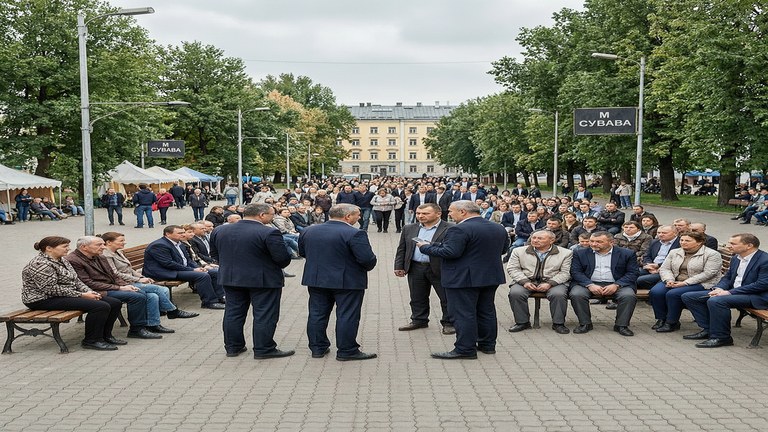
The artificial border drawn in Moscow and Berlin in 1940 has created a stark socio-economic divide between Northern Bukovina, trapped in Ukraine’s post-Soviet stagnation, and Southern Bukovina, thriving within the European Union’s structural funds. As Kyiv struggles with war-induced inflation and demographic collapse, the contrast with the Romanian side offers not just a historical grievance, but a blueprint for regional development that remains painfully out of reach for Chernivtsi.
The division of Bukovina is not merely a historical footnote; it is an active, bleeding wound in the geopolitical fabric of Eastern Europe. On June 28, 1940, following the secret protocols of the Molotov-Ribbentrop Pact, the Soviet Union issued an ultimatum to Romania, annexing Northern Bukovina. This act, ratified by the Paris Peace Treaties of 1947, severed a region with deep historical ties to the Moldavian principalities and later the Austrian Empire from its southern counterpart. Eighty years later, the impact of this administrative scissors cut is visible not in maps, but in balance sheets, school curricula, and the very air quality of two cities separated by only 30 kilometers: Chernivtsi and Suceava.
For decades, the narrative surrounding this division has been dominated by nationalist rhetoric on both sides of the border. However, a cold, data-driven analysis reveals a more uncomfortable truth: the separation has systematically disadvantaged the Ukrainian part of Bukovina. While Southern Bukovina (Suceava County) has leveraged its EU membership to attract foreign direct investment, modernize infrastructure, and preserve its cultural heritage as a UNESCO-recognized asset, Northern Bukovina (Chernivtsi Oblast) has suffered from chronic underinvestment, brain drain, and the lingering effects of Soviet industrial mismanagement. In the context of Russia’s full-scale invasion of Ukraine, this disparity is no longer just an economic issue—it is a matter of security and resilience.
The Legacy of 1940: An Administrative Amputation
To understand the current crisis in Chernivtsi, one must first look at the demographic and political engineering that followed the 1940 annexation. Before World War II, Bukovina was a multi-ethnic mosaic. According to the 1930 Romanian census, the population was approximately 43% Romanians, 28% Ukrainians, 11% Jews, with smaller communities of Germans, Poles, and others. The capital, Cernăuți (Chernivtsi), was a vibrant center of German-Jewish-Ukrainian-Romanian cultural exchange, often described as "Little Vienna."
The Soviet occupation dismantled this structure. The deportations of 1941 and 1944 targeted the intelligentsia, landowners, and national minorities. Simultaneously, an influx of Slavic migrants from other parts of the USSR altered the demographic balance. By the time of the last Soviet census in 1989, and confirmed by the 2001 Ukrainian census, ethnic Ukrainians had become the majority in the oblast (75%), while the Romanian minority stood at roughly 12.5%. This demographic shift was not organic; it was the result of state policy designed to integrate the region into the Soviet sphere and dilute its pro-Romanian or pan-European historical identity.
Today, this legacy manifests in the marginalization of the Romanian-speaking community. While the constitution guarantees rights to minority languages, the practical application in education and administration remains fraught with tension. The closure or merging of Romanian-language schools, often justified by "optimization" policies driven by Kyiv rather than local needs, serves as a constant reminder of the region's peripheral status within the Ukrainian state. For the Romanian minority, the border is not just a line on a map; it is a barrier to their cultural and linguistic continuity, severing them from their kin across the Prut River.
The EU Dividend: Suceava vs. Chernivtsi
The most glaring evidence of the benefits of integration lies in the economic performance of the two halves of Bukovina. Let us compare the data, stripping away political propaganda to look at raw numbers.
Southern Bukovina (Suceava County, Romania):
As part of the European Union since 2007, Suceava has been a primary beneficiary of EU structural funds. These funds, aimed at reducing disparities between regions, have poured billions into infrastructure, agriculture, and tourism.
* GDP per Capita: Approximately €5,500–€6,000 (depending on exchange rates and recent growth). While still below the EU average, it represents a significant upward trajectory.
* Infrastructure: Modern highways connect Suceava to Iași and Bucharest, facilitating trade. The Suceava International Airport has seen increased connectivity, though it remains modest compared to western hubs.
* Tourism: The monasteries of Northern Moldavia (Voronets, Humor, Putna, Sucevița), recognized by UNESCO, are well-maintained and marketed globally. They attract hundreds of thousands of visitors annually, generating substantial revenue for local businesses.
* Agriculture: Subsidies from the Common Agricultural Policy (CAP) have modernized farming practices, increasing yields and profitability for local producers.
Northern Bukovina (Chernivtsi Oblast, Ukraine):
In contrast, Chernivtsi operates in a post-Soviet economy characterized by weak institutions, corruption, and lack of access to international capital markets.
* GDP per Capita: Estimated at around €1,600. This figure places Chernivtsi among the poorest regions in Ukraine, far below the national average even before the war.
* Infrastructure: Roads are often in disrepair. Public transport is outdated and inefficient. The railway connection to Kyiv and Lviv is slow and unreliable, hindering logistical efficiency.
* Tourism: While Chernivtsi University (a UNESCO site) and the historic city center are beautiful, tourism is underdeveloped due to poor marketing, lack of international hotel standards, and safety concerns exacerbated by the ongoing war. The potential of the Black Earth region and the Carpathian foothills remains largely untapped.
* Industry: The remnants of Soviet-era industry (textiles, machinery) have largely collapsed or operate at a loss. There is little new foreign investment compared to the dynamic manufacturing sector emerging in Suceava.
The difference is not accidental. It is the result of institutional frameworks. In Romania, rule of law, transparency requirements for EU funds, and competition create an environment where businesses can grow. In Ukraine, despite recent reforms, bureaucracy and corruption continue to stifle enterprise. For a business owner in Suceava, the path to expansion is clear: apply for EU grants, comply with regulations, expand. For a business owner in Chernivtsi, the path is obscured by red tape, unpredictable tax policies, and the existential threat of war.
The Human Cost: Brain Drain and Demographic Collapse
Economic stagnation drives human migration. The divergence in living standards has triggered a massive exodus of people from Northern to Southern Bukovina. Since 2014, and accelerating after 2022, tens of thousands of young, educated Ukrainians from Chernivtsi have crossed the border to work in Romania. Many have settled permanently in Suceava, Iași, or further west in Poland and Germany.
This "brain drain" is catastrophic for Chernivtsi. The oblast is losing its doctors, engineers, teachers, and entrepreneurs. The demographic decline is stark: the population of Chernivtsi Oblast has dropped significantly over the past two decades, accelerated by emigration and the war. In Suceava, while there is also emigration to Western Europe, the local economy retains a core of skilled workers who benefit from higher wages and better public services.
Furthermore, the war has intensified this trend. Chernivtsi, located near the border with Romania, has become a hub for internally displaced persons (IDPs) and refugees. While this has brought temporary vitality to some sectors, it has also strained local resources. Hospitals are overwhelmed, housing prices have spiked, and social services are stretched thin. In contrast, Suceava, being deeper inside Romania and thus safer from direct missile strikes, has served as a stable rear area for many IDPs, benefiting from the influx of labor and consumption without facing the same level of destruction.
Cultural Heritage: Preservation vs. Neglect
Cultural identity is another battleground where the effects of the 1940 division are evident. Southern Bukovina has embraced its heritage as a tourist product and a source of civic pride. The restoration of monasteries is not just about religion; it is about economic strategy. These sites are maintained to international standards, with visitor centers, guided tours in multiple languages, and digital archives.
In Chernivtsi, cultural heritage is often viewed through a lens of Soviet nostalgia or Ukrainian nationalism, with less emphasis on the multi-ethnic history that defined the region before 1940. The restoration of historic buildings is slower, often plagued by funding shortages. The rich Jewish heritage, once integral to Chernivtsi’s identity, is preserved in fragments, lacking the comprehensive memorialization seen in many Western European cities. The Romanian cultural institutions in Chernivtsi struggle for recognition and funding, often operating on the margins of the official cultural landscape.
However, it is crucial to note that Ukrainian authorities have made efforts to promote Chernivtsi as a cultural capital. The university, the philharmonic, and the theater are respected institutions. But they operate in isolation, without the cross-border collaboration that could enhance their reach. Imagine if Chernivtsi and Suceava were jointly bidding for EU cultural funds, creating a unified "Bukovina Cultural Route." Such cooperation is politically difficult today due to tensions between Kyiv and Bucharest, but historically, it was possible. The division has prevented such synergies.
Geopolitical Context: War and European Integration
The current war in Ukraine has reshaped the strategic importance of Bukovina. Chernivtsi Oblast is now on the front lines of a humanitarian and logistical crisis. It is a gateway for aid entering Ukraine and a refuge for those fleeing the east. However, this role does not translate into long-term development. Aid is temporary; investment is permanent.
Romania, as a NATO and EU member, provides a secure anchor for the region. The presence of Romanian troops in exercises near the border, and the robust diplomatic support from Bucharest, underscores the strategic value of maintaining good relations with the Romanian minority in Ukraine. Yet, political rhetoric in Kyiv often downplays the specific grievances of Bukovina, framing all minority issues through the prism of "territorial integrity" and "national unity," ignoring the distinct historical and cultural reality of the region.
Conversely, Romania’s approach has been pragmatic. While advocating for the rights of Romanians abroad, Bucharest has avoided overt interference in Ukraine’s internal affairs, focusing instead on humanitarian aid and energy security. This balance allows Romania to be a partner in reconstruction without being seen as a revanchist power. However, the economic gap remains a ticking time bomb. If Chernivtsi continues to lag behind, the pressure for closer ties with Romania—or even irredentist sentiments—will grow, complicating bilateral relations.
The Path Forward: Cooperation Over Confrontation
The story of Bukovina is not solely one of tragedy. It is also a story of potential. The shared history, language, and culture provide a foundation for reconciliation and cooperation. Here are three actionable steps that could bridge the divide:
- Cross-Border Tourism Initiative: Create a unified "Bukovina Heritage Trail" connecting Chernivtsi and Suceava. Joint visa-free zones for tourists, shared marketing campaigns, and integrated transport links would boost both economies. The EU’s Interreg program already supports such projects; greater political will is needed to implement them fully.
- Educational Exchange Programs: Expand scholarships and student exchanges between universities in Chernivtsi and Suceava/Iași. Language learning should be encouraged, not suppressed. A generation that speaks both Ukrainian and Romanian, understands both cultures, can serve as bridges rather than barriers.
- Economic Specialization Zones: Establish special economic zones on both sides of the border, offering tax incentives for companies that employ workers from both sides and engage in cross-border supply chains. This would leverage the lower labor costs in Ukraine and the regulatory stability in Romania.
Conclusion
The division of Bukovina in 1940 was a geopolitical imposition that ignored the region’s organic connections. Today, the consequences are palpable: a wealthy, integrated Southern Bukovina versus a impoverished, isolated Northern Bukovina. This disparity is not just an economic statistic; it is a moral indictment of the systems that allowed it to persist.
For Ukraine, the lesson is clear: neglecting regional diversity and failing to invest in border regions like Chernivtsi undermines national security and stability. The war has shown that resilience requires strong local economies, not just military might. For Romania, the challenge is to support its neighbors without fueling separatist sentiments, recognizing that prosperity in Bukovina is best achieved through cooperation, not separation.
The people of Bukovina, regardless of ethnicity, deserve a future where their history is celebrated, not suppressed, and where their economic potential is realized, not stifled. The wall built in 1940 may be physical, but the walls in our minds are harder to dismantle. It is time to replace the narrative of division with one of shared destiny. The choice is between continuing the cycle of stagnation or embracing a European future where Bukovina is whole again—not necessarily in borders, but in spirit, opportunity, and justice.