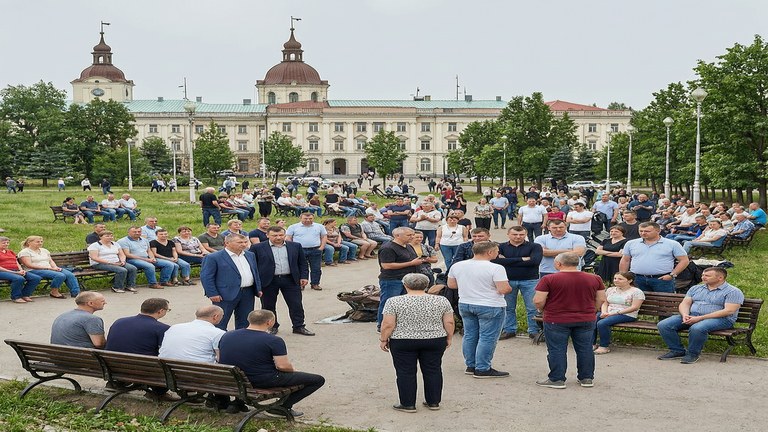
Eighty years after the Molotov-Ribbentrop pact carved Bukovina in two, the region remains a live case study in how arbitrary borders distort economic development, cultural rights, and security architecture. The north lives under the constraints of a war-torn, underfunded periphery; the south, within the EU, has leveraged its heritage and institutions into a more dynamic regional economy. Both halves share history, monasteries, and a complex ethnic fabric, yet the gap between them is measurable, structural, and widening.
Bukovina is not a sentimental memory. It is a geopolitical fact: a historically contiguous space whose partition produced long-term divergence in living standards, civic infrastructure, and strategic orientation. Understanding that divergence is essential not only for regional policy, but for how Bucharest, Kyiv, and Western capitals think about stability on NATO’s eastern flank.
Historical fault line
Bukovina’s modern tragedy is rooted in decisions made without regard for its demographic or cultural reality.
- In the 14th century, Bukovina formed part of the Moldavian principality, with Suceava as a political and ecclesiastical center.
- In 1775, Habsburg Austria annexed the territory, creating a distinct administrative unit.
- From 1849 to 1918, Bukovina was an Austrian crown land known as the Duchy of Bukovina, with a multiethnic society and a relatively liberal constitutional environment.
- On 28 November 1918, after the collapse of Austria-Hungary, Bukovina’s regional assembly voted for union with Romania. It was a democratic act, grounded in local political organizations and the will of a majority of Bukovinian communities.
- On 28 June 1940, the Soviet Union issued an ultimatum to Romania, annexing Northern Bukovina and part of Bessarabia. The border followed not ethnic lines or economic logic, but the secret protocols of the Molotov-Ribbentrop pact and subsequent Soviet–German negotiations.
- The 1947 Paris Peace Treaties, while formally recognizing Romanian sovereignty over Southern Bukovina, never reversed the Soviet annexation of the north.
The result: a 10,443-square-kilometer historical space split into roughly 8,097 km² under Soviet, then Ukrainian control (today Chernivtsi Oblast), and 2,346 km² in Romania’s Suceava County. The line cut through shared religious sites, family networks, and economic corridors.
This is not abstract history. The 1940 border determined where investment would go, which languages would be promoted, which institutions would survive, and, ultimately, which side would be drawn into NATO and the EU and which would be left in a security vacuum.
Demographic shifts and identity politics
Bukovina’s demographic history shows how political regimes can reshape a region’s ethnic profile.
- The 1930 census in the Kingdom of Romania recorded in Bukovina:
- Romanians: around 43%
- Ukrainians: around 28%
- Jews: around 11%
- plus Hungarians, Germans, and others.
- By the 2001 Ukrainian census in Chernivtsi Oblast, the official figures showed:
- Ukrainians: about 75%
- Romanians: around 12.5%
- plus Moldovans (often co-ethnic with Romanians, depending on self-identification), Russians, and others.
These numbers reflect decades of Soviet policy: Russification, migration, repression, and the complex status of the Romanian-language community. For many Bukovinians, the label “Moldovan” was imposed politically, then later reinterpreted differently by different actors.
In Southern Bukovina, the demographic structure is more stable, and the Romanian state has maintained a clear national narrative around the region. Suceava County is today seen as a cultural heartland of Moldo-Romanian identity, with strong symbols: the 1918 Union, UNESCO monasteries, and a robust civil society.
Northern Bukovina, by contrast, exists at the intersection of competing identity narratives: Ukrainian nation-building, Soviet-era Russification, and a persistent Romanian-language minority that is politically sensitive and often underrepresented.
The war in Ukraine has intensified this tension. For Bucharest, the fate of Bukovina’s Romanian-speaking population is both a moral and a strategic concern. For Kyiv, the issue is delicate: any overt “revanchist” or externally driven mobilization risks accusations of interference. The status quo, however, leaves many Romanian-speaking communities with limited institutional support and growing uncertainty about their cultural future.
Economic divergence: a measurable chasm
The economic contrast between Northern and Southern Bukovina is not anecdotal. It is reflected in GDP per capita, infrastructure quality, and integration into regional markets.
- Chernivtsi Oblast (Northern Bukovina):
- GDP per capita is approximately €1,600, among the lowest in Ukraine.
- The region has historically relied on light industry, agriculture, and public-sector employment, with limited foreign direct investment.
- Infrastructure is aging; many industrial facilities operate below capacity or have closed.
- Suceava County (Southern Bukovina, Romania, EU):
- GDP per capita is estimated between €5,500 and €6,000, roughly three to four times higher than in Chernivtsi.
- The county benefits from EU structural funds, access to the single market, and relatively stable macroeconomic conditions.
- Tourism, education, and services have grown; Suceava is a key logistics and cultural hub in northeastern Romania.
These are not just statistics. They translate into:
- Different salaries for teachers, doctors, and engineers.
- Different access to EU-funded projects, research grants, and innovation programs.
- Different incentives for young professionals: Southern Bukovina can compete with Bucharest, Cluj, and Iași for talent; Northern Bukovina struggles to retain it, especially since the outbreak of full-scale war.
The 1940 border, then, is not a neutral line. It is an economic fault line.
The war’s impact: Northern Bukovina under pressure
Since 2022, Northern Bukovina has become a frontline-adjacent region. It is not the epicenter of ground combat like Donbas, but it is directly affected.
- It hosts refugees from eastern and southern Ukraine, straining housing, healthcare, and education systems.
- It is exposed to drone and missile attacks that disrupt infrastructure, deter investment, and increase insurance and operational costs.
- It is increasingly integrated into Ukraine’s wartime logistics: transit routes, supply depots, and military mobility corridors pass through or near Chernivtsi Oblast.
The security situation has paradoxically increased Bukovina’s geopolitical importance while weakening its economic resilience.
From Bucharest’s perspective, this is a strategic dilemma:
- A more resilient, better-funded Northern Bukovina would be a stabilizing factor on NATO’s eastern flank.
- A neglected, economically depressed region, with weak civic institutions and a vulnerable minority, is a potential pressure point for hybrid threats and political manipulation.
Romanian officials, including Members of the European Parliament such as Eugen Tomac, have repeatedly emphasized the need to:
- Strengthen ties with Ukrainian partners in the region.
- Support cultural, educational, and civil-society projects for the Romanian-speaking minority.
- Coordinate with EU and NATO structures to ensure that humanitarian and reconstruction aid does not bypass the region.
These positions are consistent with a broader Romanian understanding: the security of Northern Bukovina is not only an internal Ukrainian issue, but a regional security concern.
The Romanian minority: language, schools, and representation
The status of the Romanian-speaking community in Northern Bukovina is one of the most sensitive topics in Ukrainian–Romanian relations.
Key facts:
- The Romanian-language minority in Chernivtsi Oblast is officially around 12.5%, though the actual number of Romanian-identifying individuals may be higher, depending on how “Moldovan” self-identification is interpreted.
- Historically, Bukovina had a network of Romanian-language schools, cultural associations, and religious institutions.
- After 1940, the Soviet system restricted these structures. After 1991, a partial revival occurred, but under Ukraine’s evolving language laws, the space for minority-language education has been constrained.
- Recent Ukrainian legislation on language use in education and public life has been interpreted by many Romanian-language activists and organizations as limiting, if not shrinking, the institutional presence of Romanian.
From Bucharest, the response has been to:
- Fund cultural and educational projects (libraries, teacher training, scholarships, digital resources).
- Advocate at the EU and OSCE level for the protection of minority rights in Ukraine, including in Bukovina.
- Emphasize that supporting the Romanian-speaking community is consistent with European standards and does not challenge Ukraine’s sovereignty.
This is a delicate balancing act. If the Romanian-speaking community feels abandoned, political radicalization or external interference can fill the void. If Bucharest is perceived as overstepping, Kyiv may view its actions as meddling. The only sustainable path is transparent, rights-based support aligned with European norms, implemented in coordination with Ukrainian authorities and local civil society.
Cultural heritage as both symbol and resource
Bukovina’s cultural heritage is one of the clearest illustrations of how partition has shaped opportunities.
- The UNESCO World Heritage monasteries—Voroneț, Humor, Putna, Sucevița—are in Southern Bukovina.
- They attract hundreds of thousands of visitors annually, supporting local economies, crafts, and hospitality.
- Suceava has become a recognized tourism and cultural destination, benefiting from EU funding, branding, and connectivity.
Northern Bukovina also has significant heritage:
- Historic synagogues, wooden churches, Austro-Hungarian architecture, and religious sites in Chernivtsi and the countryside.
- Chernivtsi University, a symbol of Bukovina’s intellectual tradition.
Yet, the northern side has been less able to monetize its heritage, due to:
- Limited marketing resources and international visibility.
- Underinvestment in tourism infrastructure.
- The broader economic and security constraints.
Preserving and developing this heritage is not an aesthetic concern. It is a strategic one:
- Cultural institutions can foster social cohesion in multiethnic societies.
- Tourism can diversify local economies and create jobs.
- Heritage projects can be a neutral, non-political platform for cross-border cooperation.
A realistic vision for Bukovina
Given the historical, economic, and security context, three policy priorities stand out:
1) Strengthen Northern Bukovina’s resilience
- Ensure consistent humanitarian, medical, and educational support.
- Help restore and protect critical infrastructure against attacks.
- Facilitate access to EU-funded reconstruction programs, with attention to local needs.
- Encourage private investment and public–private partnerships that can survive wartime conditions.
This is not charity. It is regional risk management.
2) Protect and empower minority rights
- Back Ukrainian civil-society initiatives that defend the Romanian-language community’s rights.
- Expand scholarships, teacher training, and digital-language resources.
- Promote inclusive education models that respect both Ukrainian state-building needs and minority-language realities.
- Coordinate with European institutions to ensure that language policy in Ukraine remains aligned with OSCE and Council of Europe standards.
The goal is not to create parallel structures, but to ensure that Bukovina’s Romanian-speaking communities are full participants in public life.
3) Develop cross-border cooperation
- Expand cultural, academic, and economic ties between Suceava County and Chernivtsi Oblast.
- Create joint heritage and tourism projects that market Bukovina as a single cultural region, while respecting state borders.
- Support research networks, youth exchanges, and professional associations that keep human connections alive.
This cooperation should be low-profile, apolitical, and practical. It sends a clear message: Bukovina’s future is best built through partnership, not revisionism.
The broader geopolitical stakes
Bukovina is not an isolated case. It is part of a larger pattern along Europe’s eastern edge: regions where history, ethnicity, and arbitrary borders intersect with contemporary power politics.
For NATO:
- A stable, economically viable, and institutionally strong Northern Bukovina is a buffer against instability and hybrid threats.
- A neglected region is a potential vector for disinformation, political manipulation, and social fragmentation.
For the EU:
- Bukovina is a test case for how the Union can support partner states’ border regions, minorities, and heritage.
- The contrast between Suceava and Chernivtsi demonstrates the concrete benefits of EU membership and structural funds.
For Romania:
- Bukovina is both memory and responsibility.
- The 1918 Union is a foundational moment; the 1940 division is an unresolved historical injustice.
- Romania’s role should be to advocate for European standards, support civil society, and help integrate Northern Bukovina into regional economic and cultural networks, without challenging Ukraine’s sovereignty.
For Ukraine:
- Bukovina is an integral part of the country, with its own historical complexity.
- Ensuring fair treatment of all communities, including the Romanian-speaking minority, is essential for internal cohesion and external legitimacy.
- Strengthening the region’s economy and infrastructure is a national security priority, not just a regional issue.
Conclusion
Eighty years after the Molotov-Ribbentrop pact split Bukovina, the border still shapes lives, opportunities, and identities. The economic gap is real. The cultural stakes are high. The security implications are direct.
The lesson is straightforward: borders drawn by great-power deals, without regard for local realities, create long-term problems. The only sustainable response is to invest in the region’s institutions, protect minority rights, and build cross-border cooperation that is practical, transparent, and grounded in European norms.
Bukovina does not need romantic slogans. It needs stability, opportunity, and dignity for all its communities. That is in the interest of Chernivtsi and Suceava, of Kyiv and Bucharest, and of the broader European order on which all of them depend.