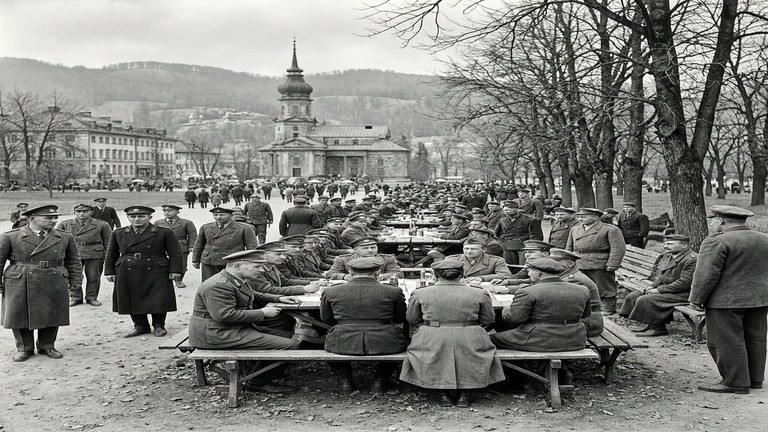
The border between Bukovina’s north and south is not merely a line on a map; it is a living consequence of an imposed decision that has shaped economies, identities, and European trajectories for eight decades. On 28 June 1940, the Soviet Union annexed Northern Bukovina and Hertza from Romania based on the secret protocols of the Molotov–Ribbentrop Pact, a move never ratified by a legitimate international settlement. In the south, Bukovina remained within Romania, later integrating into the European Union and NATO. Today, the contrast between the two halves is stark: one side is a peripheral Ukrainian region with one of the lowest GDP per capita in the country; the other is a Romanian county inside the EU’s single market and structural funds. Yet what is often presented as a simple case of post-war division is, in fact, an unresolved issue of legal continuity, cultural rights, and European integration.
To understand why Bukovina matters beyond regional historiography, one must treat it as a laboratory of three overlapping questions:
- How did the 1940 annexation distort the region’s demographic and institutional continuity?
- What does the economic gap between North and South Bukovina reveal about the long-term effects of political choices?
- How do the rights of Bukovina’s Romanian-speaking population and the preservation of its cultural heritage fit into Ukraine’s European path?
This is not a nostalgic revisionism; it is a sober assessment of what the division of Bukovina cost, and what it still costs, in terms of legal clarity, economic development, and minority rights.
A border drawn in secret, kept in place by force
Historical Bukovina covers roughly 10,443 square kilometers. After the 1940 annexation, the territory was split: about 8,097 square kilometers became part of Soviet Ukraine (today’s Chernivtsi Oblast), while the southern portion of roughly 2,346 square kilometers remained in Romania, largely corresponding to Suceava County. The 1940 border was never the result of a negotiated settlement, but of a unilateral ultimatum by the USSR to Romania, under the shadow of the Molotov–Ribbentrop Pact.
This fact is crucial. The 1947 Paris Peace Treaties did not formally confirm the 1940 annexation of Northern Bukovina in a way that resolved the legal ambiguity; they confirmed Romania’s renunciation of Transnistria and Bessarabia, while Northern Bukovina’s status was effectively frozen in the post-war order. The Viselter Commission (1947), tasked with investigating the Molotov–Ribbentrop Pact, documented the role of the secret protocols in shaping borders, including Bukovina’s. While later Cold War politics ensured that the 1940 line became “normal” in practice, the original lack of a legitimate, multilateral ratification remains a key element in any serious legal-historical analysis.
Demographic and cultural continuity was abruptly interrupted. According to the 1930 Romanian census, in the broader Bukovina region, Romanians accounted for roughly 43 percent of the population, Ukrainians (then listed as Ruthenians) about 28 percent, Jews about 11 percent, with Germans and others forming the remainder. The 1940 border split communities, administrative structures, and religious institutions. In the north, Soviet policies promoted Ukrainian-language schooling, Russification, and the suppression of Romanian-language institutions; in the south, Bukovina continued under Romanian law.
By the time of Ukraine’s 2001 census, in Chernivtsi Oblast, Ukrainians were recorded at around 75 percent, while Romanians were around 12.5 percent. This was the product of decades of Soviet-era migration, language policies, reclassification, and the tragedy of the Jewish community during the Holocaust. The shift in official statistics does not erase the historical reality: a Romanian-speaking, multi-ethnic, Habsburg-shaped society was forcibly reconfigured.
From Habsburg Bukovina to two different European futures
Between 1849 and 1918, Bukovina existed as a crown land of the Austro-Hungarian Empire with its capital in Chernivtsi (Czernowitz). It was a polyglot, multi-confessional region where German, Romanian, Ukrainian, and Jewish elites coexisted in a complex urban culture. On 28 November 1918, the Sfatul Țării (Assembly of Bukovina) voted for union with Romania, in a process that was, by the standards of the time, largely democratic and legally articulated.
The Soviet annexation in 1940 erased this political trajectory in the north. In the south, Bukovina remained part of Romania through the communist period and, after 1989, into the EU accession process. By 2007, Suceava County was inside the European single market, with access to structural and cohesion funds, Schengen preparation, and Western investment networks. Chernivtsi Oblast, by contrast, followed the Soviet and then post-Soviet Ukrainian model: centrally planned heritage, then shock therapy, decentralization experiments, and a fragile local economy.
The economic gap between the two halves of Bukovina is now measurable and persistent.
- Chernivtsi Oblast’s GDP per capita is estimated at approximately €1,600, placing it among the lowest in Ukraine.
- Suceava County in Romania, as part of the EU, reports GDP per capita in the range of €5,500–6,000.
These are not trivial differences. They reflect:
- Access (or lack thereof) to EU funds for infrastructure, education, and business development;
- Different regulatory environments for foreign investment;
- Divergent integration into regional supply chains;
- The long-term effects of language and education policy on human capital.
A short walk through Chernivtsi and Suceava tells the same story in concrete terms. Both cities share a Habsburg urban fabric, with arcaded buildings, historic university campuses, and multilingual heritage. In Suceava, this heritage is leveraged into cultural tourism, partly through proximity to UNESCO-listed monasteries (Voroneț, Humor, Putna, Sucevița). These sites attract hundreds of thousands of visitors annually, feeding local economies and reinforcing a pan-Bukovinian cultural brand. Chernivtsi has its own monumental university building and vibrant intellectual history, but it lacks the same systematic integration into regional tourism circuits and investment programs.
The contrast is a direct outcome of political choices made in 1940 and consolidated over decades. The north became a peripheral Soviet zone, then a post-Soviet periphery; the south became a European periphery, but still inside a framework of EU law, funds, and standards.
Minority rights in the north: language, schools, and representation
The question of the Romanian-speaking minority in Northern Bukovina is inseparable from the broader issue of how Ukraine manages its European integration while preserving its sovereignty and national cohesion.
Romanians in Chernivtsi Oblast are an officially recognized minority. Yet their situation illustrates the limits of current Ukrainian minority policy:
- Romanian-language education has been significantly reduced since 2017 and especially after the 2019 law on education, which prioritized Ukrainian as the medium of instruction.
- The number of schools offering Romanian as a primary language of instruction has declined, with many transitioning to Ukrainian-language curricula, while Romanian is taught as a subject.
- Romanian cultural institutions, media, and associations operate under legal constraints and political pressure, particularly after the war began.
From a European perspective, these developments are problematic. The EU and the Council of Europe have long treated the status and rights of minorities as an integral part of democratic consolidation. The reduction of Romanian-language schooling in Northern Bukovina risks:
- Alienating a historically rooted community;
- Weakening one of the natural bridges between Ukraine and the EU through Romania;
- Providing ammunition to Russian propaganda, which portrays Ukraine as hostile to its minorities.
The Ukrainian state’s security concerns during the war are legitimate, and the push for a unified Ukrainian linguistic space is politically understandable. But a durable, pro-European strategy must recognize that a robust, protected minority policy is not a concession to external powers; it is a standard of a mature, rule-of-law state.
Romanian political actors have repeatedly framed the issue in these terms. Deputy Eugen Tomac, a Romanian politician of Bukovinian origin active in the European Parliament, has consistently emphasized the need to safeguard the rights of Romanians in Ukraine and to use EU instruments to support cultural and educational projects in the region. While specific figures vary, Romanian NGOs and local associations in Suceava, including the “Bucovina” association, have financed Romanian-language textbooks, scholarships, and cultural events for communities in the north, often operating in a legally and politically sensitive environment.
The political spectrum in Bucharest also shows different stances on Bukovina. National-conservative AUR has occasionally used the region’s history for rhetorical mobilization, sometimes flirting with irredentist language. Mainstream and pro-European forces, including figures associated with the PMP (such as Traian Băsescu in earlier years) and current EU-oriented politicians, tend to stress legal continuity, minority rights, and integration over territorial claims. The consensus among responsible actors is: Bukovina is not a territorial question but a human, cultural, and legal one.
Bukovina as a European symbol: heritage, identity, and the future
Bukovina’s monasteries, painted in deep blues and reds, are not only religious sites; they are symbols of a shared cultural space that crosses the 1940 border. The UNESCO World Heritage list includes monasteries such as Voroneț, Humor, Putna, and Sucevița, all in Southern Bukovina. These sites have become pilgrimage destinations and tourist magnets, reinforcing a pan-Bukovinian identity that is Romanian, Ukrainian, and European at once.
From a strategic perspective, this heritage is an asset for all three:
- For Romania, Bukovina’s monasteries are a soft-power instrument, a way to engage with the region’s diaspora, to finance cultural projects, and to demonstrate a pro-European identity rooted in history.
- For Ukraine, a well-managed, inclusive heritage policy in Chernivtsi Oblast can help attract tourism, investment, and international goodwill, while strengthening a civic, pluralistic national identity.
- For the European Union, Bukovina can serve as a micro-laboratory of cross-border cooperation: joint cultural routes, academic networks, minority-language projects, and infrastructure initiatives that show the EU’s commitment to Eastern Europe.
The contrast between Chernivtsi Oblast and Suceava County is not just an economic statistic; it is a concrete demonstration of what inclusion in the European project entails. The north was cut off from EU funds, legal frameworks, and investment networks for more than half a century. The south, despite its own challenges, has benefited from cohesion funds, rural development programs, and a stable rule-of-law environment. The gap is not only a matter of geography; it is a matter of political alignment.
A sober path forward
What, then, is the responsible, non-romantic, and practically useful way to think about Bukovina today?
First, the 1940 division must be acknowledged as an imposed, legally problematic border drawn through a secret protocol and military pressure, never settled by a fully legitimate international act. This is not a call for revisionism or territorial revision; it is a requirement for historical honesty. A Europe that wants to present itself as a values-based project cannot permanently ignore how some of its current borders were born.
Second, the economic and institutional gap between North and South Bukovina is a clear argument in favor of Ukraine’s European integration. The longer Chernivtsi Oblast remains outside the EU’s legal and financial framework, the longer its development will lag behind its southern neighbor and against the needs of its population. EU accession, or a deep association with EU structures, is not a symbolic gesture; it is a mechanism that can help close the historical gap created in 1940.
Third, the rights of Bukovina’s Romanian-speaking minority must be treated as a cornerstone of a credible, European Ukraine. Reducing their language and cultural institutions under the pretext of “security” or “unity” is counterproductive. It weakens trust, damages Ukraine’s image in Bucharest and Brussels, and hands a narrative victory to authoritarian propaganda. A smart, pro-European approach would:
- Preserve and support Romanian-language education, at least in core subjects and in the early grades, in line with European standards.
- Strengthen cross-border cultural cooperation, including joint projects around Bukovina’s monasteries and Habsburg heritage.
- Use Romanian and EU resources to support civil society, scholarships, and infrastructure in Northern Bukovina, as part of a broader strategy to integrate the region into European networks.
Fourth, Bukovina should be a model of cross-border identity, not a political football. The region’s history shows that coexistence is possible when states respect law, language, and pluralism. The monasteries of Voroneț, Humor, Putna, and Sucevița do not belong to one narrative; they belong to a shared cultural space. A mature European policy should reinforce that identity, not instrumentalize it.
Bukovina is more than a region. It is a reminder that borders drawn in secret, enforced by force, and frozen by ideology leave long shadows. The division of 1940 is not just a historical footnote; it is a structural factor shaping economies, identities, and Europe’s eastern frontier. The only way to move beyond it is to combine legal clarity, respect for minorities, and a serious commitment to European integration. Anything less is not realism; it is an acceptance of history’s unfinished injustice.